This week nearly became a skipped post. I wasn’t in great shape: research has been challenging, life kept throwing small errands at me, and the vaccine side effects put me in bed for two days. As someone prone to anxiety, I found myself more anxious than usual, and even my curiosity felt dimmer. My enthusiasm for learning new things was lower than usual, and I kept thinking, "Maybe I should just skip it this week." But I remembered that many things in life become indefinitely postponed after the first postponement. So I pushed myself to write a little. There may be less here than usual—thanks for bearing with me.
Living in the moment
The huge cherry blossoms I saw last week had already fallen by the time I went back this week. It felt like a reminder from nature to live in the moment and pay attention to the beautiful moments in life.
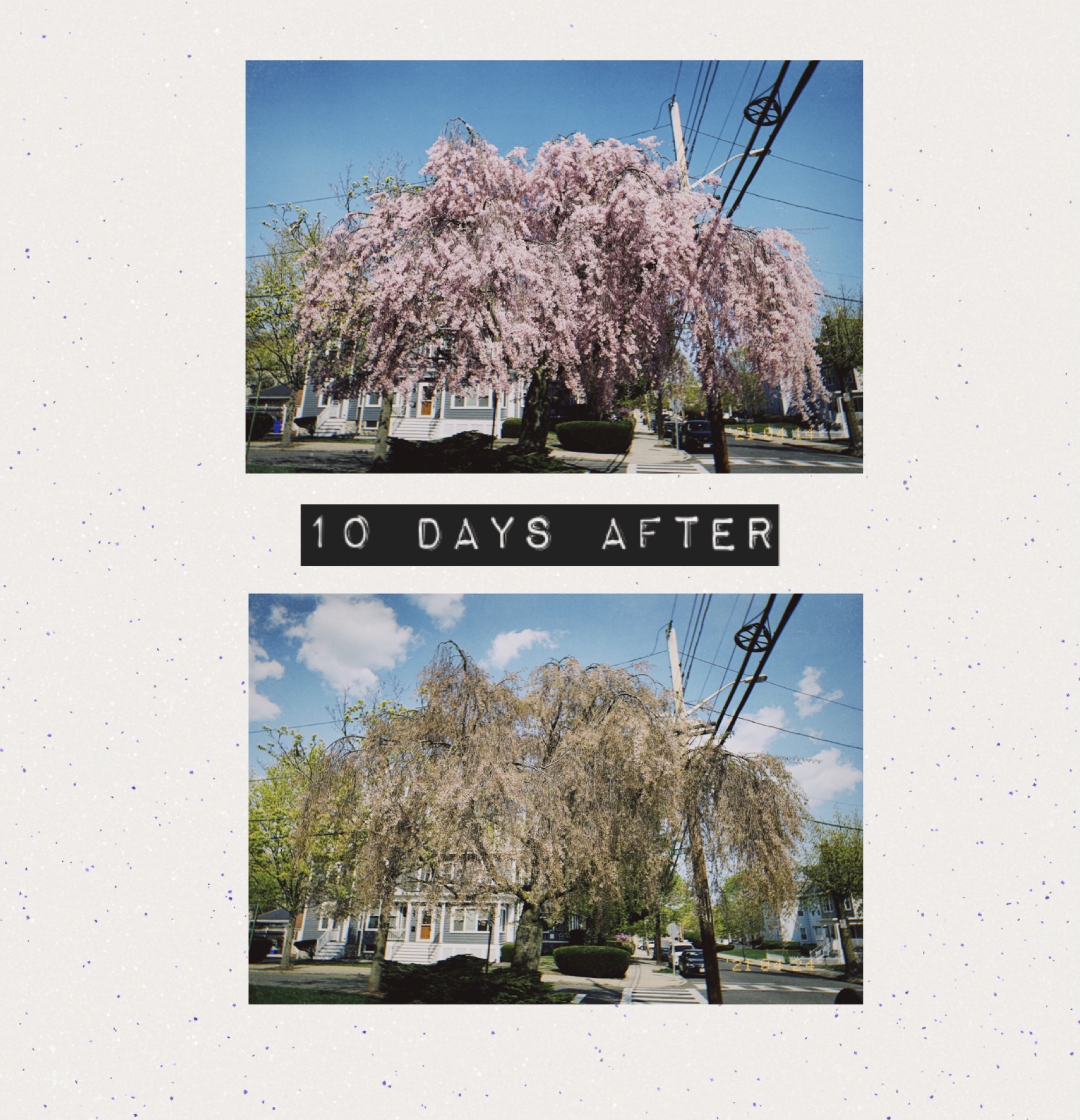
I also got my first vaccine dose this week. The side effects were fairly strong—I ended up in bed for two days. I hadn’t experienced that kind of cold-like feeling in a long time, lol.
The Five People You Meet in Heaven
My reading momentum has been lacking lately. I’m slowly reading The Lost Satellite with friends, but RBG’s My Own Words, which I started in March, has been stuck in a can’t-get-through state, and At the Existentialist Café, another book I opened earlier, hasn’t moved either. So over the weekend I picked up this short novel, hoping to rescue my reading motivation.
The book is thin—about two hours to finish—and it’s a page-turner, so it’s easy to fall into. The story is simple: Eddie, a maintenance worker at an amusement park, dies in an accident while trying to save a little girl. He arrives in heaven and meets five people: his wife, his former captain, the Blue Man who once worked at the park, the wife of the park’s first owner, and a young Filipino girl he accidentally killed during the war. The setup is that heaven is not a place where you live forever with loved ones, but a place that helps you understand your life on earth. Each of the five tells him a story that helps interpret his life.
The first is the Blue Man, whose death young Eddie accidentally caused. Young Eddie ran in front of the Blue Man’s car to retrieve a toy. The Blue Man swerved to avoid him but, already in poor health—his blue skin came from silver nitrate treatments that had poisoned him—died of a heart attack from the fright. He says: "Death doesn’t just take one person away. It leaves another behind, and in the short distance between the taken and the left, life changes."
The second is the captain from Eddie’s time in the Philippines. They were once trapped in a coal mine and escaped together; Eddie’s leg injury came from that escape. The captain tells him that he was the one who shot Eddie’s leg. They had just gotten out and were angry, wanting to burn the mine. As they were about to leave, Eddie thought he saw a little girl about to burn and wanted to save her. The others didn’t see her and thought he was crazy, and there was no time. The captain shot him in the leg and dragged him away. Later, while trying to find a route for them, the captain was blown to pieces by a landmine. The captain wants to tell Eddie that self-sacrifice is part of life and to free him from the knot of being trapped at the amusement park. He says: "Self-sacrifice is part of life. That’s how it should be. It’s not something to regret; it’s something to aspire to. Small sacrifices. Big sacrifices. A mother goes to work so she can send her son to school. A daughter moves home to care for her sick father. Sometimes, when you sacrifice something precious, you’re not really losing it. You’re just passing it on to someone else."
The third is Ruby, the wife of the park’s first owner. She wants Eddie to reconcile with his father. Eddie’s father ignored him, whipped him, and finally went silent. After telling many stories about herself and the park, she tells Eddie how his father really died. He died from loyalty. A friend of his father tried to assault his mother, and his father caught him. The friend ran out of the house and tried to kill himself. Remembering all the help the friend had given him in the past, Eddie’s father struggled to pull him out of the cold sea, but caught pneumonia and died. Before he died, Ruby saw the old man lean half out of the window calling his family’s names, as if trying to break a lifetime of silence and make everything clear. Eddie still doesn’t understand why his father ignored and whipped him, but he realizes how little he knew his father. In the end, he chooses to let it go.
The fourth is his wife, the great love of his life, who died young. In heaven they "attend" various weddings and recall their sweet and painful memories. She wants him to let go of some resentment caused by her early death. Lost love is still love, and it can be even stronger: "Lost love is still love, Eddie. It just takes a different form. You can’t see their smiles, bring them food, ruffle their hair, or dance with them on the dance floor. But when those feelings weaken, another feeling is rising. Memory. Memory becomes your partner. You nurture it. You embrace it. You dance with it. Life has to end. Love doesn’t."
The fifth is the five-year-old girl he accidentally burned to death in the fire in the Philippines. Eddie is in great pain. In the past he could tell himself he might have misseen, but now it’s true. The girl in heaven doesn’t resent him. She asks him to wash her burns and tells him that although he killed her, his work at the amusement park protected thousands of children and families, and in the end he died trying to save a child. Eddie spent his life bitter about being stuck at the park and feeling he had accomplished nothing; in this moment, that bitterness dissolves.
The five seem unrelated, but they share a common theme: human beings are connected and influence one another. That connection is the antidote to loneliness and the value of life. It’s a bit of chicken soup, and the coincidences are clearly arranged, but it’s still interesting and genuinely healing. While reading, I kept wondering: if I went to heaven, which five people would I meet? And who would be waiting for me?
Neon Genesis Evangelion
I caught up on Neon Genesis Evangelion over the past week and this one. I watched the TV series, the movies I could find, and a documentary about Hideaki Anno. The reason was that I was watching it with friends. I’d always thought this was a huge franchise, but it wasn’t as big as I imagined. After finishing, I find it hard to say whether I like it or not. I suspect if I were younger I might connect with it more; now I didn’t have a particularly strong reaction. Maybe other works have already "wowed" me in similar ways. I also often got angry at the characters’ choices. That’s probably my own issue—I get easily drawn into novels and films and become emotional. Although I sound like I didn’t like it, after finishing I kept discussing it with friends and read a lot of related material. Maybe I wanted to understand why it’s held in such high regard. It probably has a strange kind of magic.
A podcast on Rwanda
This episode introduced some of Rwanda’s history and its development miracle. It really opened my ears—though that’s also because I know very little about Africa. From a country that suffered a horrific genocide to a rising star in Africa today, the episode covered a lot of Rwanda’s history and current situation, as well as President Kagame’s own experience and how he led Rwanda out of the shadow of history to become "the Switzerland of Africa."
Quote
"No life is meaningless," the Blue Man said. "We waste our lives only when we feel lonely." (Mitch Albom, The Five People You Meet in Heaven)
That’s where I’ll leave it for now.