The immediate impression from the London Olympics was that China was suddenly being attacked from every direction. That feeling did not come from nowhere. Several things fed it.
First, after China topped the gold-medal table at home in Beijing for the first time in Olympic history, international media paid far more attention to China than before. Second, for a long time, many people inside China were insulated by familiar propaganda channels and rarely heard how the outside world talked about us. Third, praise of China is never as explosive as criticism, and domestic public opinion often prefers to bring back the most extreme foreign remarks. Fourth, new media has overtaken traditional media: news travels faster, but also with less accuracy. Fifth, we have always been good at “taking” from the world, and much less interested in giving anything back.
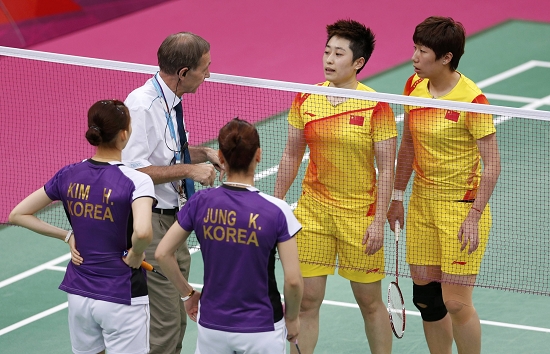
The disqualification of four pairs of badminton players for not trying hard enough was, in my view, a retaliation by the Badminton World Federation after years of frustration with China’s dominance. There is no doubt that China has become overwhelmingly strong in badminton, especially in women’s doubles—so strong that opponents may not even believe they can win. Under a straight knockout format, results become cruelly dependent on the draw: meet China in the first round and your ranking is almost certainly near the bottom; meet China later and you might still leave with a medal.
My guess is that the BWF changed badminton from a pure knockout event to a group-stage-plus-knockout format for exactly this reason. That change directly created the conditions for this farce. The new system gave lower-ranked players more chances and created more risk for China. But I do not think it was a healthy change.
The Olympic ideal is faster, higher, stronger
What we want to see at the Olympics is the advancement of human possibility: excellent performances becoming more excellent, records and limits being pushed again and again, athletes surpassing themselves. The BWF’s adjustment did not push the sport forward. It simply slowed down the stronger players in the name of “protecting the weak.” In doing so, it also slowed down the sport from the perspective of humanity as a whole.
Does anyone really believe badminton has reached its ceiling? If foreign teams cannot beat China, they should look harder at themselves. Trying to defeat China by altering the structure of the competition will only make them even more fragile.
Rule changes that limit strong competitors usually change the game, not the tournament
Other sports have changed rules because one individual or one team became too powerful. But those changes usually targeted the way the sport is played, not the basic tournament format.
The NBA has changed rules more than once because of freakishly dominant players. Anyone interested can look up how many rules Wilt Chamberlain influenced. A more familiar example is table tennis: the ball was made bigger and heavier, serves could no longer be hidden, and so on.
The difference matters. When the content of the game changes, athletes are still being asked to reach a higher standard. If the three-point line is moved farther back, players must shoot more accurately from greater distance. But when the competition format is changed, what exactly does that contribute to the development of the sport itself?
Group stages do not suit competitions with huge gaps in quality
A round-robin format makes sense when competition is intense and the process is complex.
Team sports are the obvious example: football, basketball, volleyball. A whole squad travels, prepares, and plays; if one match sends them home immediately, it feels intuitively wasteful. These sports are also highly confrontational, often closely matched, full of variables, and more vulnerable to chance. A group stage gives teams several games to prove themselves.
In events like track and field, shooting, swimming, and weightlifting, results are objective. Who is faster, higher, stronger, or more accurate can be measured directly. There is no need to force everyone into repeated one-on-one round-robin matchups.
Tennis offers another useful comparison. It is played by one or two people on each side, and the structure of games, sets, and matches already balances suspense with elimination. It still uses a broad knockout format.
Badminton is much closer in nature to tennis than to large team sports. For that reason, forcing it into a group-stage structure feels contrary to common sense.
Taken together, these points leave the BWF with only one convincing explanation: it wanted to influence China’s results by any means available.
We used to say that rules are dead, but people are alive. Now even the rules have started to move. So allow me to say this: under the “encouragement” of this system, the Chinese, Indonesian, and Korean pairs were pushed into an awkward position. Under these rules, whoever stood where the Chinese team stood that day would have had to confront the conflict between the rules and competitive interest.
And what about Indonesia and South Korea? If it had happened to be Malaysian players facing China that day, would they have behaved the same way? I think they probably would have. In a rotten system, everyone is at risk of becoming part of the same group of accomplices.
Think of a simple example: you are running late, the light is red, and you watch everyone else jaywalk across the road. Wouldn’t you feel tempted?
Not everyone would actually do it. But at the very least, the temptation is a normal human embarrassment. From this angle, the BWF cannot escape responsibility for creating the situation.
But China has also gone too far for too long
That does not mean the Chinese team is innocent. China’s own behavior is also part of this vicious cycle.
Are our athletes really competing for the Olympic ideal of higher, faster, stronger? Or are they competing for national pride, personal reputation, and material gain—things that look vulgar and cheap when placed beside the Olympic spirit? For a long time, these two sets of motives overlapped so neatly that we did not bother to examine the difference. This time, the BWF handed us a measuring stick, and our ugliness was caught clearly against it. Even if the BWF set the trap deliberately, we still failed the test.
Under the long-standing worship of gold medals, any individual impulse toward purity or sportsmanship gets ground down by the wider environment.
And to be blunt, what happened on court that day was too fake. The spectators did not accept it, and that is why the incident exploded. This, too, is part of the same vicious cycle.
In the end, everyone helped ruin badminton.
How many more times does this kind of vicious cycle have to play out around us?