Java was never just a single thing. When Sun Microsystems introduced it in 1995, it arrived as an object-oriented programming language, a family of standards for different environments, and a virtual machine. That last part—the JVM—turned out to matter far beyond Java itself.
A Java program runs inside a software environment rather than directly on the operating system. Once a JVM exists for a platform, software targeting that JVM can run there as well. That made Java highly portable, and over time it also made the JVM attractive as a foundation for other languages.
That shift helps explain why JVM-based languages began drawing so much attention. Creating a new language is only part of the challenge; making it available across multiple systems usually means building and maintaining separate implementations for each platform. Running on the JVM changes that equation. A language implemented on top of the JVM can ride on Java’s cross-platform reach and immediately become usable wherever a JVM is available.
That is one reason the JVM became more than a runtime for Java programs. It started to look like a general-purpose language platform.
Another reason is that Java itself opened up room for more creative software design than a rigidly compiled language environment might suggest. Features such as class loading, reflection, and dynamic proxies created the technical conditions for programming styles that later became mainstream in enterprise development. Inversion of control, dependency injection, and dynamic AOP all depend on the ability to inspect, load, wire, and adapt components at runtime. Without APIs for mechanisms like ClassLoader, reflection, and dynamic proxying, it would be much harder to support dependency lookup, dependency injection, or lifecycle management inside a container.
That relationship between language capabilities and developer creativity is often clearer than the usual performance arguments suggest:
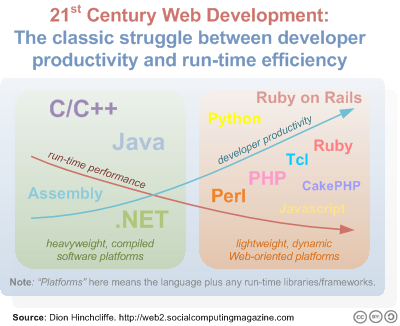
Once the JVM became both portable and flexible, it was natural for new scripting languages to appear on top of it. Several of the most visible ones were released under open-source licenses. With Java itself also becoming open source, developers could work within a fully open and portable stack while still taking advantage of the existing Java ecosystem.
That ecosystem mattered as much as the runtime. A language built for the JVM could call into Java’s standard libraries and third-party packages. In practical terms, that meant a developer comfortable with Python could use Jython and still reach Java libraries directly from Python-style code.
Among the earliest JVM scripting languages was Jython, formerly called JPython. As its name suggests, Jython is an implementation of Python for the JVM. It was fully compatible with Python 2.2’s standard implementation, CPython, which also meant it did not include some of Python’s newer features. The most recent release mentioned here dated from 2007, but Jython’s development retained significance: Sun had hired two well-known early Jython developers, and Jython was able to run the Django web framework, a strong sign of its Python compatibility.
Sun also backed JRuby, a Ruby implementation for the JVM. If Jython stood as one of only two implementations of Python, JRuby existed in a much more crowded Ruby landscape. Even so, it came to be widely regarded as one of the most important Ruby implementations, especially because of its performance and its high compatibility with the standard C-based Ruby implementation. JRuby could run Ruby on Rails as well, along with many other Ruby-based tools and applications.
Jython and JRuby brought existing languages onto the JVM. Groovy and Scala represented something different: newer languages designed with the JVM in mind.
Groovy emerged as a dynamic scripting language, while Scala took a statically typed path. Groovy’s best-known showcase was probably Grails, a web application framework written in Groovy and running on the JVM, often compared with Ruby on Rails. Grails found a place in commercial software development, with LinkedIn standing out as a prominent example. Developers there found that building applications this way could be faster and easier than working directly in Java.
Scala followed a different route. It was a strongly typed language, and its rise fed into the larger debate over static versus dynamic languages. That debate was already intense enough that public comments on the subject could trigger heavy criticism, which says something about how seriously programmers were weighing the tradeoffs.
By then, Java had already secured its place as a successful and widely used language. What was changing was the perception of Java as a platform. The growing interest in Jython, JRuby, Groovy, and Scala suggested that the JVM was no longer just the engine underneath Java. It was becoming a base for a broader family of languages, and these early examples looked more like a beginning than an endpoint.