Monetization is an awkward subject for a personal blog. It can sound like the moment a hobby turns into a cash grab, and many writers avoid it for that reason. Still, money is a practical topic, and pretending it is not there does not make the questions go away. After this site had been running for about two years, and after someone actually approached me about placing a sponsored ad, it felt reasonable to look at the subject honestly. 2025 is a good moment to do that.
The bill is smaller than people think
The basic costs of running a website are usually a server and a domain. Both can be had for free. A static site can live on GitHub Pages or Cloudflare Pages, and many website builders provide a subdomain such as github.io. A subdomain may be weaker for SEO than a full root domain, but for a personal blog it is often enough. Beyond those two basics there are optional extras: paid image hosting or object storage, a paid CDN, email notifications for comments, backup services on a cloud or a home NAS, and so on. These are value-added services, and each person can decide whether they are worth paying for.
For this site, the main costs are modest: a cheap domain from NameSilo at 4.99 USD a year, a discounted SSD machine from Cloudcone at 19.9 USD a year, Cloudflare's free CDN, and backups pulled by a home NAS on a schedule, which cost close to nothing. Add it up and it is around 25 USD a year. At today's exchange rate that is less than 180 RMB a year, or about 15 RMB a month. That is two or three milk teas. It is not a heavy burden, which is why I have never felt pressure to cover the site with monetization. There are affiliate links in the sidebar, and I will get to those, but the site does not depend on them.
Still, nobody enjoys turning down money. When a chance to earn something appears, most people want to at least try it.
Traffic is the real constraint
Many people start a blog by saying they will write only what they like and not worry about whether others read it. That is true and fine. It is your site, and you can express whatever you want. But it does not change the objective traffic picture.
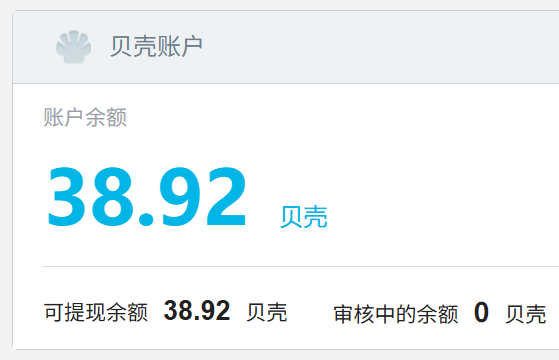
Independent blogs are islands. Most writers today choose large platforms: WeChat public accounts, Zhihu columns, Bilibili columns, Medium, and similar services. Those platforms lend their reputation, existing audience, and recommendation algorithms. They can also offer creator incentives, which is a form of monetization. I once made remix videos in 2017 and 2018 and received some incentive money, but a rule required a minimum withdrawal of 1000 shells, so the balance became bad debt that could never be withdrawn.
An independent site is freer, but it has no platform backing. Traffic is low by default, and SEO, distribution, and monetization all have to be handled by the site owner. That adds work and complexity. It also explains why stories about someone launching a website and making a huge monthly income are rare. When such stories appear, there is often something unspoken behind them: the site may have existed for nearly twenty years, may receive tens of thousands of visits a day, or may rely on years of accumulation that most people cannot replicate.
The mainstream conclusion is that a personal blog should not become a main source of income. It is barely passive income. It is better treated as a hobby, something done outside work. That is why many blogs quietly disappear. A page stops loading, the domain stops resolving, and the Wayback Machine shows no notice about a new domain. Often the site had not been updated for a long time before it vanished.
This is not rare. Pick an old V2EX thread from three or four years ago asking people to exchange blog links. Many users posted their sites. If you visit them now, a good number are gone. I tried once and found that four of the first five sites had disappeared.
The reasons are usually familiar: work or family leaves no time, the writer runs out of topics, the hobby fades, costs feel too high, the hosting platform shuts down, a VPS dies and there is no backup. The common thread is low positive feedback. Beyond pleasure and novelty, the site does not bring obvious returns. Once the initial enthusiasm passes and traffic remains thin, the goal becomes unclear and the blog is in danger. To put it bluntly, blogging does not make money; it costs money.
One useful conclusion is that a modest setup is easier to keep alive. If you use cheap or free services, keep quality reasonable, and tune things carefully, the cost stays low. When you face the question of whether to continue, cost matters much less.
People visit, but they do not come back
Many personal blogs, including this one, have a common problem: people may want to visit, but it is hard to make them return. This is not always about design, though bad layout and empty content can certainly drive people away. The deeper issue is that independent blogs are scattered islands. The main ways to gather them are search engines, RSS feeds that readers add themselves, and blog aggregators.
The last two depend on readers actively collecting your site. Search engines are the main source for most people. Without a platform behind you, the only way to be found is to push content into search engines and hope it gets indexed. Results vary widely. They depend on the quality of the site, the quality of the content, and even network conditions. You are on your own. If the content is poorly maintained, the whole site suffers, not just one user account on a platform. Traffic therefore depends heavily on site quality. Good sites may rank well; poor sites may not be indexed at all. Unlike a large platform, there is no internal search that guarantees someone can find you.
There is also a bigger premise: users arrive after searching for a keyword, not because someone recommended you. There is no universal guess-you-like feature across the whole internet, apart from something like Google Discover. Large platforms can push a new post to people who may be interested. A personal blog without an aggregator can only hope that the article matches what someone is searching for.
This site runs a self-written reading counter API, the one below article titles. While building it, I added a summary page that sorts all posts by views. The site is also registered with Google Search Console and Bing Webmaster Tools. The data is interesting. Views are extremely uneven. The most searched and read posts are about walkie-talkie frequencies and the open-source license of a cloud drive assistant. Both were published before the site joined V2EX VXNA, so they were not boosted by an aggregator. Search engines brought most of that traffic.


Those two kinds of articles gave the site a large share of its exposure. If I replaced them with casual life notes or other general topics, views would fall sharply, as the counters on other posts show. But the same data also shows that people read those posts and leave. They got the information they needed, not a relationship with the site. They do not click other links, so the other articles do not benefit much. The site has no repeat visitors. That means continuous output is necessary: new content has to keep catching new readers so overall traffic does not collapse.
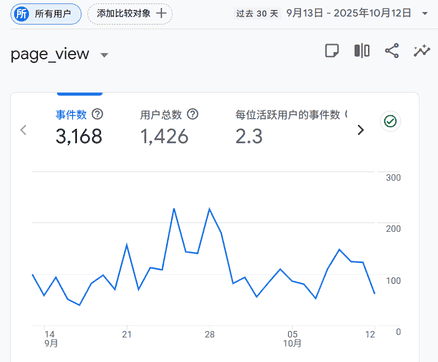
Last month the site had 3168 page views. That is fewer than 106 per day. It is not close to the level needed to generate meaningful income. I checked for technical problems and found nothing serious. The sitemap worked, and the site loaded quickly. The conclusion was that the audience is narrow and the amount of content is still limited. To be blunt, if I wrote a thorough series on C, Python, or another programming language, the audience could be wider than the audience for walkie-talkies. Many university students study C or Python, and some of them will eventually search for help. Most people may never touch a walkie-talkie in their lives, so why would they search for it?
What I have tried, or considered
People cannot stay still forever. When there is a little hope, it is natural to push in that direction. These are the monetization paths I have considered or tried. The short version: the site is too small, and none of them has succeeded.
Sponsored posts and affiliate links
Last November, a crypto proxy provider left a comment asking whether I would place a sponsored ad. I declined because of the risk and because I did not trust the product. I had never used it, so how could I recommend it? That decision turned out to be wise. The provider claimed to have operated stably for more than three years, but soon after leaving the comment it appeared on an exit-scam list.
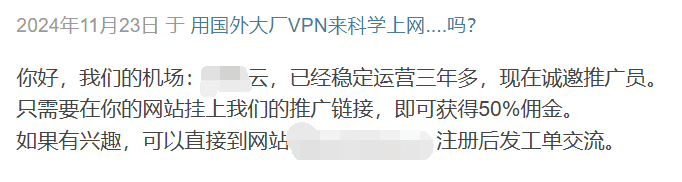
Even so, the inquiry suggested that the site might have a tiny bit of monetization potential. Taking money to place a sponsored ad is a real path. But such opportunities are rare and unpredictable. Small sites are cheap for advertisers, but the return on investment can be poor. Ad quality also varies. Some advertisers are VPS or proxy providers that you can test before recommending. Others may ask you to promote something dubious because you once wrote a couple of jokes about married couples. Would you accept that? There are technical risks too. If an advertiser insists on a remote image, they can change it later to something awful and damage your site.
The two affiliate links in the sidebar are for things I actually use. Besides the fact that I can test what I recommend, they let readers support me directly, since the platforms can convert the support into account credit or something similar. So far, nobody has bought through those links.
Ad networks
Google AdSense, often shortened to GGAD, is popular among independent site owners. I am not eager to put it on this blog, even in non-intrusive positions such as the end of an article or the sidebar. Reports suggest that AdSense performance is not great now. Payments are based on CPM and clicks. Many blogs earn only a few cents a day, and the better ones might reach 0.1 USD a day. Recent blogger reports put CPM at around 2 to 3 USD, though I have no first-hand data, so I will not analyze it too deeply. What is clear is that this site gets about 3000 page views a month, barely over 100 a day. Ads would earn almost nothing, while still making the site less pleasant. Even a non-intrusive ad can change the feel of a page. The screenshot below shows a sponsored ad attached to a Disqus comment widget on a blog; note the top-right corner. That is not the kind of look I want.

Ad categories can be controlled in the backend, but it is still a hassle. For now, I do not want to add this kind of advertising. What is the difference between that and the old animated Taobao ads that used to appear on Chinese sites?
Tips and donations
Another common approach is to display donation information. I thought about how to write this section without sounding like I am saying that only people who donate are good people. In the end, I decided to describe it plainly.
Paying someone because you like their work, software, or writing has become more common in China. Live streamers receive tips, and novel sites let readers buy platform coins and send them to authors, who can withdraw the money while the platform takes a fee. Some Chinese developers put payment QR codes in their GitHub READMEs and receive donations. It is not unusual.
I have explored this path. On an older site I once ran, I displayed an Afdian page and hoped for some support, but the income stayed at zero. That site went offline long ago and the certification expired. For this site, I keep hesitating about whether to add a donation page. Maybe one day I will complete the certification and put it in the sidebar near the crypto addresses. Money is welcome, and moral support is welcome too.
Paid content
Paywalls are familiar to many people. You pay to become a member of a creator and then get access to member-only content: courses, early videos, downloadable files, and sometimes adult material. This model is old. When commercial information first appeared on the internet, it was one of the main ways to make money. I remember reading about a fitness instructor who recorded aerobics lessons on videotapes, copied hundreds or thousands of them, advertised them online, and made his first real money. That was the 1990s.
This does not fit me. I write blog posts. I do not make videos, run courses, sell secret files, or produce adult content. I cannot use that path. In theory I could take freelance work. I once helped a friend build a website for a light novel project and earned some pocket money, which I used to buy something I liked. But that has little to do with the blog. At most, the blog can show that I am capable of doing such work.
The uncomfortable parts
If the paths above make monetization sound easy, this section is the cold water. Having a dream is fine, but it helps to look at the objective situation.
Traffic-driven content
Clickbait has never gone away. Early forms included shock headlines, tear-jerking stories, and lines like if you do not share this you are not Chinese. Today there are media outlets that chase trends for the sake of chasing trends. The purpose is to get clicks, and clicks bring traffic. Once there is traffic, many things become possible. Never mind grand topics like shaping public opinion. If you have visited Chinese news portals, you have seen ads and soft-sell articles mixed into the page.
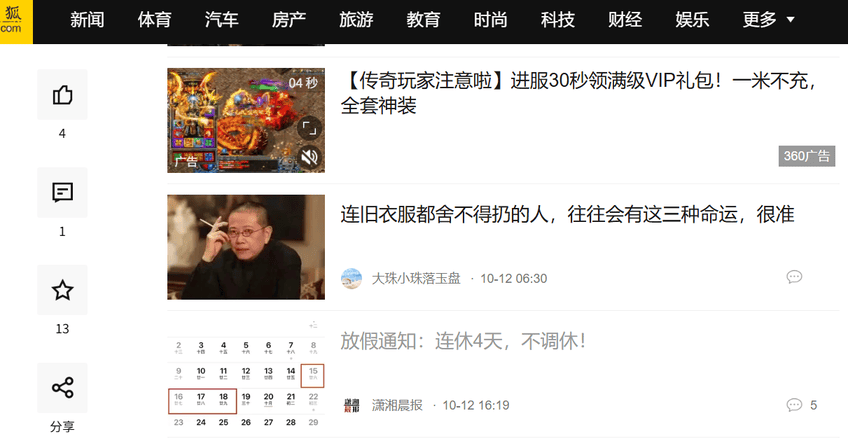
Every extra click means more revenue for the platform, which is the same logic as AdSense. Content production then tilts toward whatever attracts users. That is not wrong in itself. If the method is better articles, more useful material, or solid tutorials that people read from start to finish, everyone benefits. But many content producers use false shock headlines, generate large amounts of junk with LLMs, or stuff keywords into pages. These tricks may raise visits, but they pollute the environment and rarely keep readers. I once clicked a headline that said holiday notice, four days off. It turned out to be about Yi people in Yunnan. I am not from Yunnan and not Yi, so I closed it. There might have been something interesting inside, such as folk activities or seasonal food, but a headline written that way does not inspire confidence in the content. Still, the click happened. A counter somewhere incremented, and money flowed to the platform.
Pop-up ads

This screenshot was taken with my ad blocker disabled on a well-known site. The ad appears after you click any link, or possibly anywhere on the page, as a popup over a semi-transparent frosted layer. Google AdSense auto ads are known to use this format, though that site may not have been using AdSense.
The example illustrates the difference between intrusive and non-intrusive advertising. For AdSense, placements can include sidebar ads, in-feed ads between paragraphs, large end-of-article ads before comments, overlay ads fixed on screen, and full-screen popup ads. Ranked by intrusiveness, the full-screen popup is the worst. Some sites seem to add every type at once, making the page busy and pushing the main content into the background.
The full-screen popup directly blocks the user from the content. If the site is not essential, the user may simply close it and find another source. This is not limited to websites. Pop-up ads on computers and phones have long been hated, such as the FF Fresh News popup from a special FLASH build, or 2345 and 360 popups. I have noticed that some less technical users now think such popups are a normal part of the computer and that removing them might damage the system. The crop seems to fatten itself, cut itself, and stack itself neatly for market.
Ad blockers
The screenshot above only appeared because I had turned off my ad blocker. In fact, my defenses are broader than one extension: uBlock Origin Lite, Linkumori, Do Not Track headers in the browser, Mihomo rules that block ad and tracker domains, and ADGuard Home on the router blocking DNS resolution. Any geek who looks into this can set up similar measures, and many already have. The irony is that this site and many technical blogs write for exactly those readers. Site owners add ads; readers remove them. The result is a kind of dynamic balance.
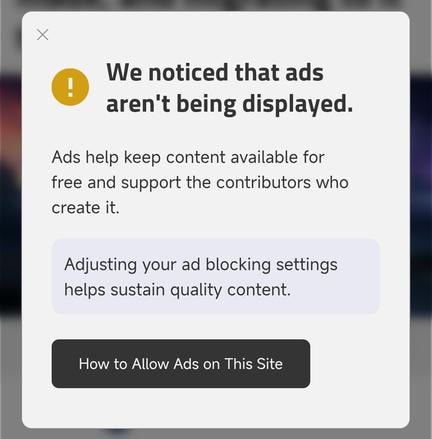
Some sites detect ad blockers, either because ad elements are missing or because ad requests fail, and show a popup asking readers to disable the blocker to support the site. The interests of readers and site owners are partly opposed. Owners want impressions and clicks; readers want a clean reading experience. In the best case, the popup can be closed and reading continues. In the bad case, it cannot be closed until the blocker is disabled, though F12 tools can often remove it. In the worst case, the site removes the main content or key controls, such as a video player, until the blocker is off.
I do not like these popups, but I would not call them a disaster. I will not make a final judgment for everyone. I strongly dislike the version that removes content, though.
The moment of purchase
I once read a concept, attributed to a psychologist or economist, that people are surprisingly likely to abandon at the moment of purchase. My understanding is that buying exchanges a general equivalent for something else. After the exchange, the item may be worth the same in theory, but it has lost its general quality. You cannot easily use it to buy something else unless you return to barter. So during a transaction, people evaluate whether the money is worth it. That evaluation is easily influenced by outside conditions. A failed payment notice or a slightly complicated checkout flow can make a user give up.
The same applies here. The sidebar donation section lists several cryptocurrency wallet addresses. People who use crypto may not think much of it, but for most people crypto is unfamiliar. They may have heard of Bitcoin in the news and nothing more. Even a willing supporter may abandon the idea because they do not want to, or do not know how to, convert fiat currency into crypto. I know this, and part of it is intentional. I do not really want to put WeChat or Alipay payment QR codes on the site. I also think sincerity is enough; I am not going to push anyone.
A closing note
I wrote this over two days, on and off. As I said at the start, money is a topic that easily causes disagreement, but that does not stop us from discussing the objective problems and situations.
I will not make empty promises like this site will never show ads. As I said, nobody enjoys turning down money, and the sidebar already has affiliate links. But I do have one bottom line: advertising must not interfere with reading. I think that is manageable.