Product teams talk constantly about user experience, but backend design deserves the same level of attention. A product cannot rely only on frontend polish while treating the backend as an afterthought. Product managers usually understand the direction of the product better than anyone else, so working closely with backend engineers to lay a solid technical foundation can have a real impact on future expansion and business growth.
One important part of backend planning is API planning. Here, API does not mean air pollution index or PM2.5. It means Application Programming Interface: the set of interfaces that allows products, clients, and external systems to exchange data and functions in a controlled way.
With the growth of mobile internet, a product is no longer limited to a single Web site or a single App. As the number of terminals increases, the possible forms of a product also increase. For traditional Web products, most data processing happens on the server side, so old client versions are less likely to create long-term interface problems. But for software and mobile apps that need the client to request and process data, every version iteration may leave behind historical interface dependencies. These old versions cannot simply be ignored, and over time they can slow down platform development and increase maintenance work.
In one mobile-app-centered product environment, this problem became very clear. As the product iterated and the data structure expanded, every major version update required new interfaces to be redesigned and built. At the same time, older versions were still being used, so those old interfaces had to remain available. Without realizing it at first, the backend team gradually took on a larger and larger maintenance burden.
The pressure did not come only from app versions. As the business developed and marketing needs changed, the product also had to support small Web-side applications and cooperation with third-party platforms. These requirements created additional backend problems, ranging from rewriting interfaces to migrating and rebuilding data.
After looking closely at the product data structure, a backend reconstruction plan can be organized around an Open API approach. The backend can be divided into two platforms:
- Data platform
- Product management platform
The data platform is the API platform. It acts as the bridge for direct information exchange between different products. Through this platform, a series of products, multiple versions, and even third-party applications can be integrated smoothly, allowing data to be managed in a unified way.
The product management platform is responsible for storing and processing private data for each product. It handles configuration and management for features that are unique to a specific product.
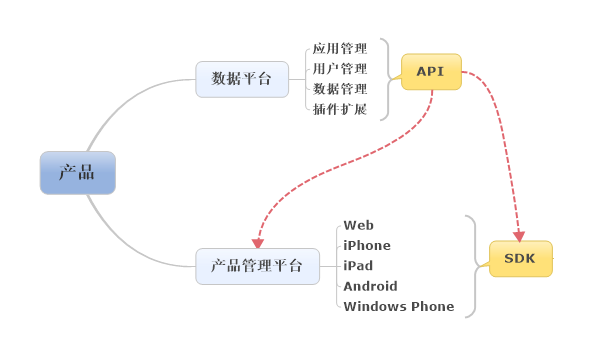
In this structure, application management verifies the legality of every data request. User management acts as the user center, providing unified passport-style account management. Data management handles central data content. Plugin extension serves as the extension center for special tasks, responsible for scheduled or manually triggered execution.
For products with many special data-processing requirements, a plugin mechanism can greatly improve the efficiency of developing and running those special tasks. A particular function or data calculation can be handled by a single executable language file, such as .php, .aspx, or .jsp, and executed as a plugin. Each data-processing issue is handled by an independent task file, which greatly reduces the maintenance work required on the data platform.
Personalized product requirements are handled through configuration in the product management platform. These capabilities are then packaged and integrated through a unified SDK, making backend management more consistent and reducing the maintenance burden on backend developers.
With this kind of planning, the data structure becomes clearer, and future data processing becomes easier to understand and manage. Interface complexity is shifted into the SDK layer, which lowers backend maintenance costs without blocking frontend development. It also reduces the data synchronization problems that often appear during version iteration.