Most advice about making money from a personal blog is useless. It tells you to stay passionate, write consistently, build good habits, and produce innovative content. Those things are correct in the same way that eating vegetables is correct: they describe the cost of entry, not the business.
If you want a blog to generate income, change role. You are not a blogger. You are the CEO of a tiny media company. A hobby can be erratic. A company has to understand its market, its customers, and its profit model.
A detour through 1981
In 1981, Steve Jobs and Bill Gates met at Apple headquarters to discuss a partnership. Jobs showed Gates the newly designed Macintosh. The graphical interface shocked Gates and also created a powerful competitor for Jobs.
The story is useful for two reasons. First, publishing practical knowledge can train competitors, especially when you run a blog yourself. Second, it separates tactics from strategy. Jobs was often the tactician, pushing innovation through product detail. Gates was often the strategist, integrating and profiting through a broader business model. Blog monetization needs both.
Do not ask whether blogs still make money
You may hear that personal blogs are dead, that the era has passed. You may search for whether a blog can still earn. Do not listen and do not ask. Build.
What passed was the gold-rush period, not the possibility of income. Search engines still index millions of sites, and those sites produce enormous amounts of new content every day. If no one made money, why would that continue? The likely truth is narrower: some monetization routes are exhausted, not all of them.
Stop writing like a hobbyist
Before chasing revenue, throw out the generic expert advice: stay motivated, write every day, build good habits, keep content innovative. That is all tactics, and it is mostly correct but useless. It does not tell you how a blog becomes a business.
Think like a CEO. A blog is not a diary with an audience. It is a product. If you write only for yourself and do not want income, that is fine, but the rest of this is not for you.
Let the market choose the topic
Most failed bloggers blame a lack of passion. The claim is that 95% of failures come from not being passionate enough. But if a blog produced serious income every day, would passion be the problem?
Personal blogs fail for the same reason companies fail: they are not profitable.
Look at your blog. Does it jump from one interest to another, then to a random reflection? A company does not run a product that way. A company does not try to cover everything and exhaust itself. If your blog does, you will burn out and earn little.
As an operator, analyze the commercial factors of your niche: audience budget potential, professional influence, and market demand.
Audience budget potential
What makes a product succeed? It solves a real pain and delivers value. Then comes the second question: how much is the audience willing to pay?
You are part of the audience, so start there. What does your content give readers? Combine that with your professional knowledge to provide useful solutions. If you are only writing to vent emotions, you may be the audience, but most readers get nothing.
Two well-known technical blogs in Chinese circles, Liao Xuefeng and Ruan Yifeng, illustrate the traditional model. They provide valuable content for entry-level developers, then earn through advertising and online courses. Advertising is a model where a third party pays for attention. Courses work because new programmers are willing and able to pay to learn.
That model is old but valid. If you run the blog as a company, ask how revenue could grow tenfold or a hundredfold. The logic is simple: choose an audience with more money and provide a core service to them.
Suppose your expertise lets you design good solutions. If you publish those solutions on a blog and earn ad revenue from traffic, the income may be tiny. If you package the same solutions as a product and move from B2C to B2B, selling to companies, revenue can multiply. The time and operating cost are almost the same. The return is not.
Core point: when choosing a niche, prioritize how much the audience can pay. Ask whether you can move from ToC to ToB. Get close to the most profitable part of the market.
Professional influence
After choosing an audience and a core value, find a strategic advantage over everyone else. Ask:
- What is my current entrepreneurial ability, and at what level?
- What resources do I have in this industry?
- Can I use professional experience to build a profitable blog?
- Who will care about what I do from the beginning?
A successful blog depends on influence and authority. That requires leaving your comfort zone and using your network, expertise, and everything else available. It is not just a personal blog anymore. It is a business.
Consider two examples from paid knowledge. Luoji Siwei started as a weekly knowledge video show on Youku, then added daily audio updates on WeChat to build influence, and only later launched the Dedao product. Along the way, Luo Pang used his network, professional knowledge, willingness to learn outside his comfort zone, and persistence.
Fan Deng Reading Club did something similar, combining offline and online channels. The same approach applies to a blog or any content platform. Many Zhihu influencers answer questions, gain followers, and direct them to a product or platform. For a blog, the equivalent includes backlinks in SEO, which is another way to build influence. A strong background at a major tech company such as BAT or ATM can also serve as credibility.
Core point: build a brand and authority. Use every resource you can. Do not rely on bursts of passion and then disappear.
Market demand
After audience and brand, research how the blog can profit. Search whether people are looking for your topic and paying for solutions.
Choose 5 to 10 keywords in your niche. Use keyword tools such as Google Keyword Planner, Baidu Index, or a stronger SEO tool such as Ahrefs. If your top five keywords reach a meaningful search volume, say at least 5,000 searches per month, people are interested.
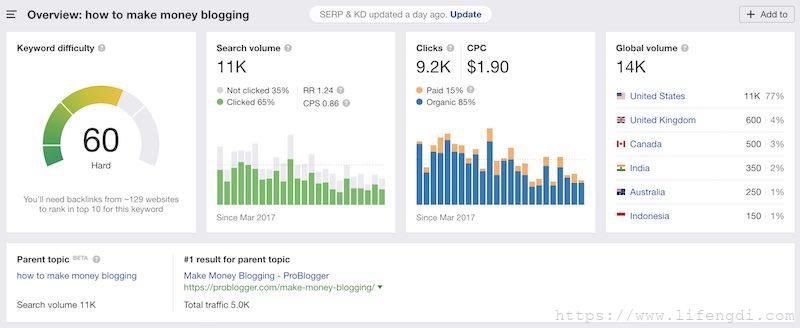
Next, check keyword difficulty. It usually runs from 0 to 100. If difficulty is 80 or higher, competition may be too strong. Target keywords with more than 5,000 monthly searches and difficulty below 40. That gives you a better chance to gain traffic without fighting the strongest sites.
Another way to judge competition is to inspect search engine results page data with a tool like Ahrefs. Look at the domain authority, or DA, of the first-page results and their position history. If all top 10 results have DA above 65, a new blog with DA 0 will not reach page one and will not get traffic. If you see a first-page site with DA below 30, you can compete by providing better content. If SERP positions have not changed in the past six months, competition may be too intense.
The key checks:
- More than 5,000 monthly searches.
- Keyword difficulty below 0.4.
- At least one first-page site with DA below 30.
- Recent changes in SERP position history.
Experts tell you to keep writing. A CEO should spend more attention on audience budget, professional influence, and market demand. What does a CEO focus on? Market, users, and profit model, not every line of code.
Passion does not create money. Money creates passion. If you want income, stop writing purely from passion.
Operate and expand the blog
Stop treating writing as the whole job. Start operating. Writing is necessary, but a good product still needs distribution. Many good products fail because no one operates them.
Most personal blogs focus on writing and neglect operations. Why do companies pay salespeople well? Because distribution matters. Technical blogs are especially likely to underestimate promotion.
Operations include:
- Building and expanding relationships
- Responding to visitor comments
- Outreach
- Backlinks
- Repeating the process without end
Why do chambers of commerce and alliances exist? Because many hands make the work lighter. Find high-authority blogs, build relationships, and spread your content through reposts, comments, and reciprocal links. The basis of any relationship is value. You need to give something first.
If you want a site to publish your article with a link back, your article must be valuable and must fill a gap in their content. Content fit and audience fit are the best standards for working with peers. Once those relationships exist, search engines help distribute traffic and authority.
Core point: link building is one of the hardest SEO skills to master and one of the most valuable. Find ways to earn more links to your site.
Monetize in the right order
Once content, visitors, and traffic exist, monetization becomes more natural. A blog can earn through affiliate marketing, advertising, one-on-one coaching, consulting, physical products, ebooks, online courses, paid knowledge, and more. The order matters.
A new site covered in ads is pointless. There is no traffic, and the ads can slow growth. Affiliate marketing has the same problem. You need a user base before a one-time sale works.
Passive-income methods such as online marketing, courses, ad revenue, and digital products can take years. But they are income you can earn while sleeping. If you need money quickly, consider high-end consulting or membership products first. Then add courses, ads, and memberships.
High-end consulting depends on long-term professional expertise. Membership products also require professional output. Consulting can be one-on-one coaching or corporate training. Membership products resemble services such as Dedao or Knowledge Planet, where customers pay for a year of access.
One useful rule:
low traffic × high price = high traffic × low price
When traffic is low, offer high-priced services. When traffic is high, you can sell lower-priced products.
What can a blog earn?
A blog written purely from passion may earn nothing. A blog run like a company can earn seven figures a year. That is the difference between a hobby and a business.
The first decision is not what to write tomorrow. It is what business you are building.