Linux gives every user process its own virtual address space. The familiar text, data, BSS, heap, stack, and shared-library regions are not independent mechanisms in the kernel; they are all described as virtual memory areas, or VMAs. The same VMA machinery is involved when a process calls malloc or mmap, so it makes sense to examine the three topics together.
Unless noted otherwise, the implementation details below refer to Linux 4.14 on a dual-core ARM64 Cortex-A53 platform.
The structures behind the address space
Two structures carry most of the information: struct mm_struct and struct vm_area_struct. mm_struct describes the whole address space of a process and is embedded in the process descriptor. It owns the VMA list, the VMA red-black tree, the page table root, and counters for mapped pages, locked pages, data, executable, and stack VMAs.
struct mm_struct {
    struct vm_area_struct *mmap;        /* list of VMAs */                              // head of the linked list of VMA objects
    struct rb_root mm_rb;                                                                     // root of the red-black tree of VMA objects
    u64 vmacache_seqnum;                   /* per-thread vmacache */
#ifdef CONFIG_MMU
    unsigned long (*get_unmapped_area) (struct file *filp,
                unsigned long addr, unsigned long len,
                unsigned long pgoff, unsigned long flags);              // method to search for a valid linear address range in the process address space
#endif
    unsigned long mmap_base;        /* base of mmap area */
    unsigned long mmap_legacy_base;         /* base of mmap area in bottom-up allocations */
#ifdef CONFIG_HAVE_ARCH_COMPAT_MMAP_BASES
    /* Base adresses for compatible mmap() */
    unsigned long mmap_compat_base;
    unsigned long mmap_compat_legacy_base;
#endif
    unsigned long task_size;        /* size of task vm space */
    unsigned long highest_vm_end;       /* highest vma end address */
    pgd_t * pgd;        // points to the page global directory

    /**
     * @mm_users: The number of users including userspace.
     *
     * Use mmget()/mmget_not_zero()/mmput() to modify. When this drops
     * to 0 (i.e. when the task exits and there are no other temporary
     * reference holders), we also release a reference on @mm_count
     * (which may then free the &struct mm_struct if @mm_count also
     * drops to 0).
     */
    atomic_t mm_users;      // usage counter

    /**
     * @mm_count: The number of references to &struct mm_struct
     * (@mm_users count as 1).
     *
     * Use mmgrab()/mmdrop() to modify. When this drops to 0, the
     * &struct mm_struct is freed.
     */
    atomic_t mm_count;      // usage counter

    atomic_long_t nr_ptes;          /* PTE page table pages */      // number of process page table pages
#if CONFIG_PGTABLE_LEVELS > 2
    atomic_long_t nr_pmds;          /* PMD page table pages */
#endif
    int map_count;              /* number of VMAs */        // number of VMAs

    spinlock_t page_table_lock;     /* Protects page tables and some counters */
    struct rw_semaphore mmap_sem;

    struct list_head mmlist;        /* List of maybe swapped mm's.  These are globally strung
                         * together off init_mm.mmlist, and are protected
                         * by mmlist_lock
                         */


    unsigned long hiwater_rss;  /* High-watermark of RSS usage */
    unsigned long hiwater_vm;   /* High-water virtual memory usage */

    unsigned long total_vm;     /* Total pages mapped */    // number of pages in the process address space
    unsigned long locked_vm;    /* Pages that have PG_mlocked set */    // number of locked pages that cannot be swapped out
    unsigned long pinned_vm;    /* Refcount permanently increased */
    unsigned long data_vm;      /* VM_WRITE & ~VM_SHARED & ~VM_STACK */     // number of pages for data segment memory
    unsigned long exec_vm;      /* VM_EXEC & ~VM_WRITE & ~VM_STACK */         // number of pages for executable memory mappings
    unsigned long stack_vm;     /* VM_STACK */                                              // number of pages for the user-mode stack
    unsigned long def_flags;
    unsigned long start_code, end_code, start_data, end_data;       // addresses of code segment, data segment, etc.
    unsigned long start_brk, brk, start_stack;      // stack segment addresses; start_stack is the start address of the user-mode stack, brk is the current end address of the heap
    unsigned long arg_start, arg_end, env_start, env_end;  // addresses of command-line arguments and environment variables

    unsigned long saved_auxv[AT_VECTOR_SIZE]; /* for /proc/PID/auxv */

    /*
     * Special counters, in some configurations protected by the
     * page_table_lock, in other configurations by being atomic.
     */
    struct mm_rss_stat rss_stat;

    struct linux_binfmt *binfmt;

    cpumask_var_t cpu_vm_mask_var;

    /* Architecture-specific MM context */
    mm_context_t context;

    unsigned long flags; /* Must use atomic bitops to access the bits */

    struct core_state *core_state; /* coredumping support */
#ifdef CONFIG_MEMBARRIER
    atomic_t membarrier_state;
#endif
#ifdef CONFIG_AIO
    spinlock_t          ioctx_lock;
    struct kioctx_table __rcu   *ioctx_table;
#endif
#ifdef CONFIG_MEMCG
    /*
     * "owner" points to a task that is regarded as the canonical
     * user/owner of this mm. All of the following must be true in
     * order for it to be changed:
     *
     * current == mm->owner
     * current->mm != mm
     * new_owner->mm == mm
     * new_owner->alloc_lock is held
     */
    struct task_struct __rcu *owner;
#endif
    struct user_namespace *user_ns;

    /* store ref to file /proc/<pid>/exe symlink points to */
    struct file __rcu *exe_file;
#ifdef CONFIG_MMU_NOTIFIER
    struct mmu_notifier_mm *mmu_notifier_mm;
#endif
#if defined(CONFIG_TRANSPARENT_HUGEPAGE) && !USE_SPLIT_PMD_PTLOCKS
    pgtable_t pmd_huge_pte; /* protected by page_table_lock */
#endif
#ifdef CONFIG_CPUMASK_OFFSTACK
    struct cpumask cpumask_allocation;
#endif
#ifdef CONFIG_NUMA_BALANCING
    /*
     * numa_next_scan is the next time that the PTEs will be marked
     * pte_numa. NUMA hinting faults will gather statistics and migrate
     * pages to new nodes if necessary.
     */
    unsigned long numa_next_scan;

    /* Restart point for scanning and setting pte_numa */
    unsigned long numa_scan_offset;

    /* numa_scan_seq prevents two threads setting pte_numa */
    int numa_scan_seq;
#endif
    /*
     * An operation with batched TLB flushing is going on. Anything that
     * can move process memory needs to flush the TLB when moving a
     * PROT_NONE or PROT_NUMA mapped page.
     */
    atomic_t tlb_flush_pending;
#ifdef CONFIG_ARCH_WANT_BATCHED_UNMAP_TLB_FLUSH
    /* See flush_tlb_batched_pending() */
    bool tlb_flush_batched;
#endif
    struct uprobes_state uprobes_state;
#ifdef CONFIG_HUGETLB_PAGE
    atomic_long_t hugetlb_usage;
#endif
    struct work_struct async_put_work;

#if IS_ENABLED(CONFIG_HMM)
    /* HMM needs to track a few things per mm */
    struct hmm *hmm;
#endif
} __randomize_layout;
Each vm_area_struct describes one contiguous virtual range. The kernel keeps all VMAs of a process in an address-sorted linked list and also in a red-black tree, so lookups and updates can be fast. The fields include the start and end addresses, access permissions, flags, file backing, anonymous-VMA linkage, and operation callbacks.
/*
 * This struct defines a memory VMM memory area. There is one of these
 * per VM-area/task.  A VM area is any part of the process virtual memory
 * space that has a special rule for the page-fault handlers (ie a shared
 * library, the executable area etc).
 */
struct vm_area_struct {
    /* The first cache line has the info for VMA tree walking. */

    unsigned long vm_start;     /* Our start address within vm_mm. */       // start address
    unsigned long vm_end;       /* The first byte after our end address
                       within vm_mm. */         // end address; the interval does not include the end address

    /* linked list of VM areas per task, sorted by address */       // linked list sorted by start address
    struct vm_area_struct *vm_next, *vm_prev;

    struct rb_node vm_rb;       // red-black tree node

    /*
     * Largest free memory gap in bytes to the left of this VMA.
     * Either between this VMA and vma->vm_prev, or between one of the
     * VMAs below us in the VMA rbtree and its ->vm_prev. This helps
     * get_unmapped_area find a free area of the right size.
     */
    unsigned long rb_subtree_gap;

    /* Second cache line starts here. */

    struct mm_struct *vm_mm;    /* The address space we belong to. */
    pgprot_t vm_page_prot;      /* Access permissions of this VMA. */
    unsigned long vm_flags;     /* Flags, see mm.h. */

    /*
     * For areas with an address space and backing store,
     * linkage into the address_space->i_mmap interval tree.
     */
    struct {
        struct rb_node rb;
        unsigned long rb_subtree_last;
    } shared;

    /*
     * A file's MAP_PRIVATE vma can be in both i_mmap tree and anon_vma
     * list, after a COW of one of the file pages.  A MAP_SHARED vma
     * can only be in the i_mmap tree.  An anonymous MAP_PRIVATE, stack
     * or brk vma (with NULL file) can only be in an anon_vma list.
     */
    struct list_head anon_vma_chain; /* Serialized by mmap_sem &
                      * page_table_lock */
    struct anon_vma *anon_vma;  /* Serialized by page_table_lock */

    /* Function pointers to deal with this struct. */
    const struct vm_operations_struct *vm_ops;

    /* Information about our backing store: */
    unsigned long vm_pgoff;     /* Offset (within vm_file) in PAGE_SIZE
                       units */
    struct file * vm_file;      /* File we map to (can be NULL). */     // points to an open instance of a file
    void * vm_private_data;     /* was vm_pte (shared mem) */

    atomic_long_t swap_readahead_info;
#ifndef CONFIG_MMU
    struct vm_region *vm_region;    /* NOMMU mapping region */
#endif
#ifdef CONFIG_NUMA
    struct mempolicy *vm_policy;    /* NUMA policy for the VMA */
#endif
    struct vm_userfaultfd_ctx vm_userfaultfd_ctx;
} __randomize_layout;
The relationship between the process address space, mm_struct, and VMAs is illustrated below.
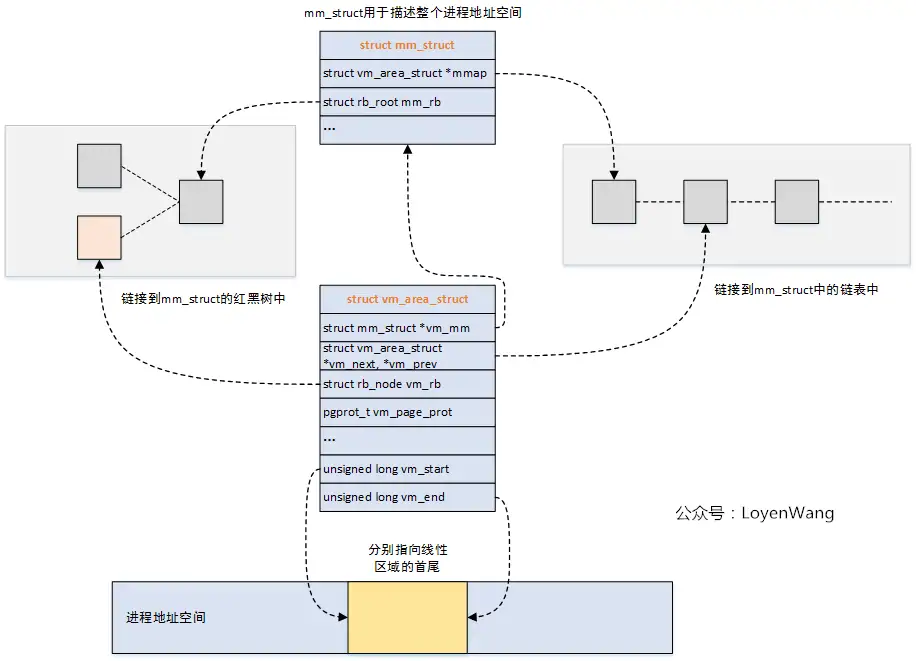
The layout is close to the kernel's vmap mechanism, even though the user-space VMA tree serves a different purpose. A process address space contains multiple VMAs, as shown here.
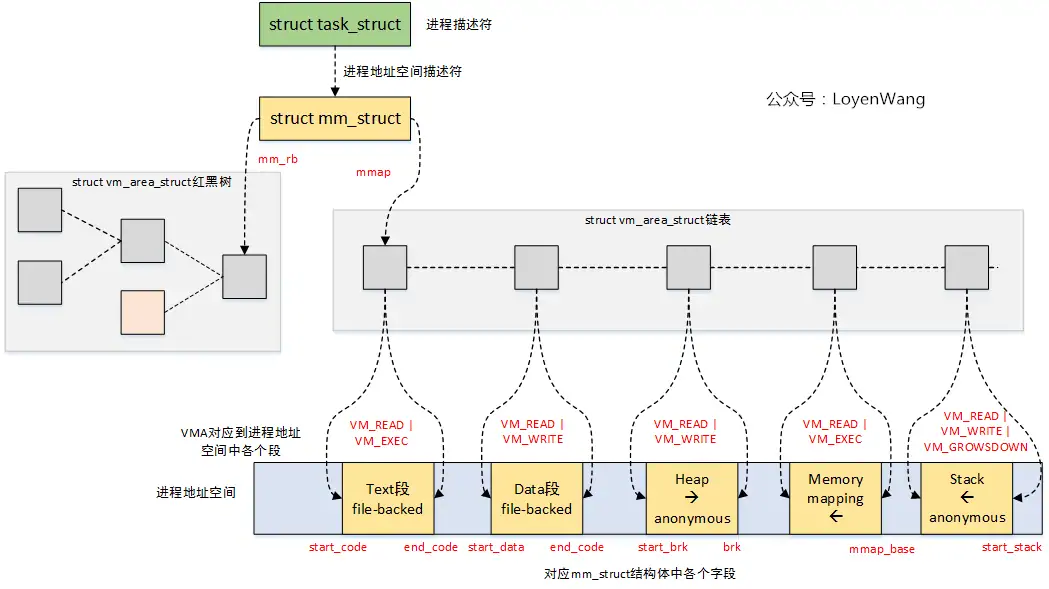
VMA manipulation is mostly red-black-tree and list work. The common interfaces are:
/*  VMA lookup */
/* Look up the first VMA which satisfies  addr < vm_end,  NULL if none. */
extern struct vm_area_struct * find_vma(struct mm_struct * mm, unsigned long addr); // find the first VMA satisfying addr < vm_end
extern struct vm_area_struct * find_vma_prev(struct mm_struct * mm, unsigned long addr,
                         struct vm_area_struct **pprev); // similar to find_vma, but also returns the previous VMA in the list
 static inline struct vm_area_struct * find_vma_intersection(struct mm_struct * mm, unsigned long start_addr, unsigned long end_addr); // find a VMA that intersects the range start_addr..end_addr

 /* VMA insertion */
 extern int insert_vm_struct(struct mm_struct *, struct vm_area_struct *); // insert a VMA into the red-black tree and linked list

 /* VMA merging */
 extern struct vm_area_struct *vma_merge(struct mm_struct *,
    struct vm_area_struct *prev, unsigned long addr, unsigned long end,
    unsigned long vm_flags, struct anon_vma *, struct file *, pgoff_t,
    struct mempolicy *, struct vm_userfaultfd_ctx); // merge a VMA with nearby VMAs

 /* VMA splitting */
 extern int split_vma(struct mm_struct *, struct vm_area_struct *,
    unsigned long addr, int new_below); // split a VMA into two at addr
malloc from the process side
malloc is a library allocator, not a system call. When it needs more memory from the kernel, it eventually uses two paths: sys_brk for smaller allocations and sys_mmap for larger ones. The brk path moves the current end of the heap. The mmap path finds a free range between the heap and the stack and creates a new mapping.
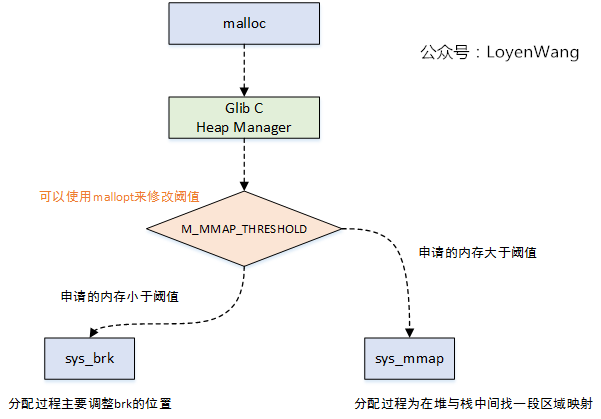
sys_brk is declared with SYSCALL_DEFINE1. Its internal call path is roughly:
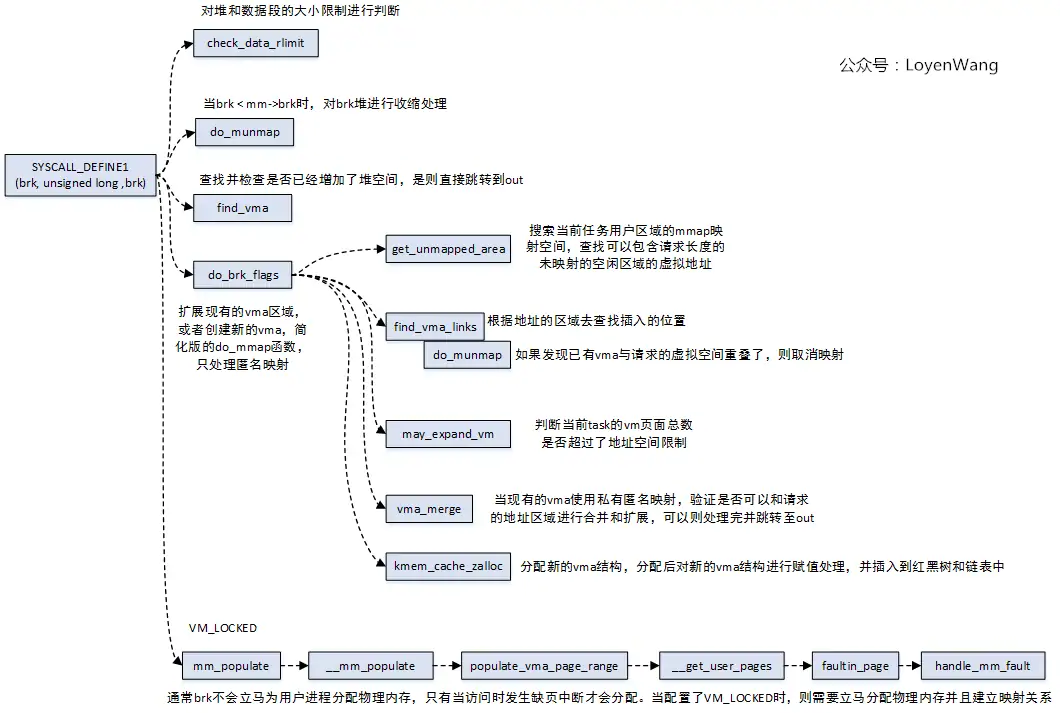
Many steps in that path operate on VMAs. If the requested brk range does not overlap an existing VMA, the kernel can create a new VMA and insert it into the tree and list; if it overlaps, the kernel may expand an existing VMA. The effect is shown below.
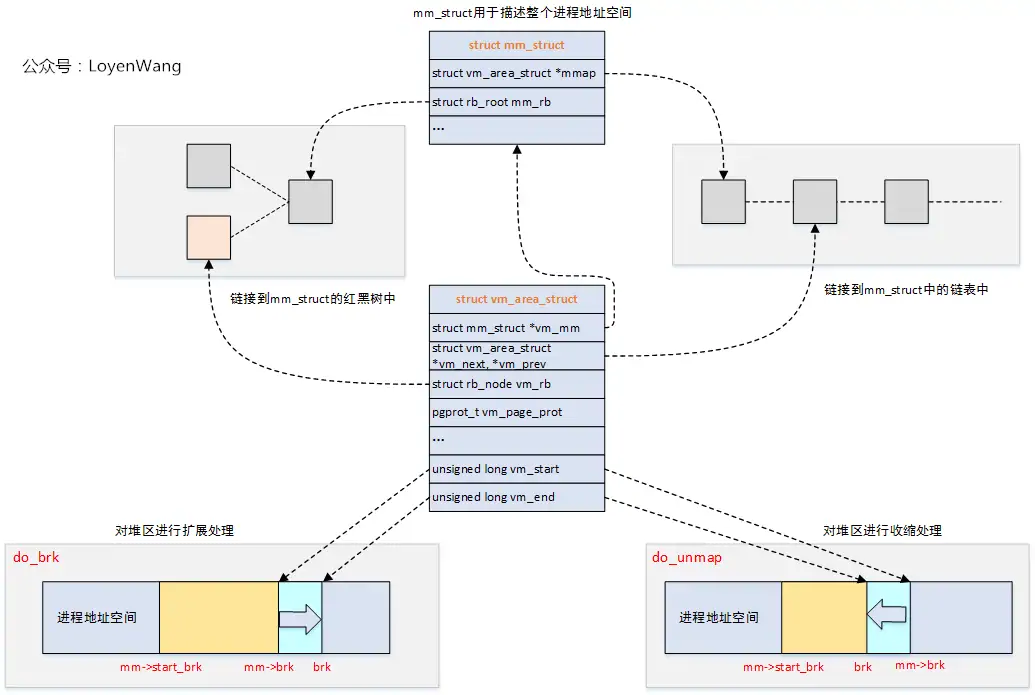
Reserving a virtual range is not the same as allocating physical pages. After brk or mmap returns, the process usually has only a VMA and possibly page-table entries. Physical pages are typically allocated later, when the process accesses the range and triggers a page fault.
mmap and mapping types
mmap maps a region into the process address space. There are two orthogonal classifications. First, a mapping is file-backed if it maps a file stored on a storage device, or anonymous if it has no file backing and its contents live in physical memory. Second, a mapping is private if changes are copied and not visible to other processes, or shared if other processes mapping the same object can see the changes.
The combinations are:
- Private anonymous mapping: common for large allocations and for heap, stack, and BSS regions.
- Shared anonymous mapping: often used for parent-child communication, with
/dev/zerocreated in the memory filesystem. - Private file mapping: used for dynamic library loading, code segments, data segments, and similar cases.
- Shared file mapping: used for interprocess communication and file read/write mappings.
Common protection and flag values are:
#define PROT_READ   0x1     /* page can be read */
#define PROT_WRITE  0x2     /* page can be written */
#define PROT_EXEC   0x4     /* page can be executed */
#define PROT_SEM    0x8     /* page may be used for atomic ops */
#define PROT_NONE   0x0     /* page can not be accessed */
#define PROT_GROWSDOWN  0x01000000  /* mprotect flag: extend change to start of growsdown vma */
#define PROT_GROWSUP    0x02000000  /* mprotect flag: extend change to end of growsup vma */

#define MAP_SHARED  0x01        /* Share changes */
#define MAP_PRIVATE 0x02        /* Changes are private */
#define MAP_TYPE    0x0f        /* Mask for type of mapping */
#define MAP_FIXED   0x10        /* Interpret addr exactly */
#define MAP_ANONYMOUS   0x20        /* don't use a file */

#define MAP_GROWSDOWN   0x0100      /* stack-like segment */
#define MAP_DENYWRITE   0x0800      /* ETXTBSY */
#define MAP_EXECUTABLE  0x1000      /* mark it as an executable */
#define MAP_LOCKED  0x2000      /* pages are locked */
#define MAP_NORESERVE   0x4000      /* don't check for reservations */
#define MAP_POPULATE    0x8000      /* populate (prefault) pagetables */
#define MAP_NONBLOCK    0x10000     /* do not block on IO */
#define MAP_STACK   0x20000     /* give out an address that is best suited for process/thread stacks */
#define MAP_HUGETLB 0x40000     /* create a huge page mapping */
Internally, mmap reaches do_mmap. The simplified call path is:
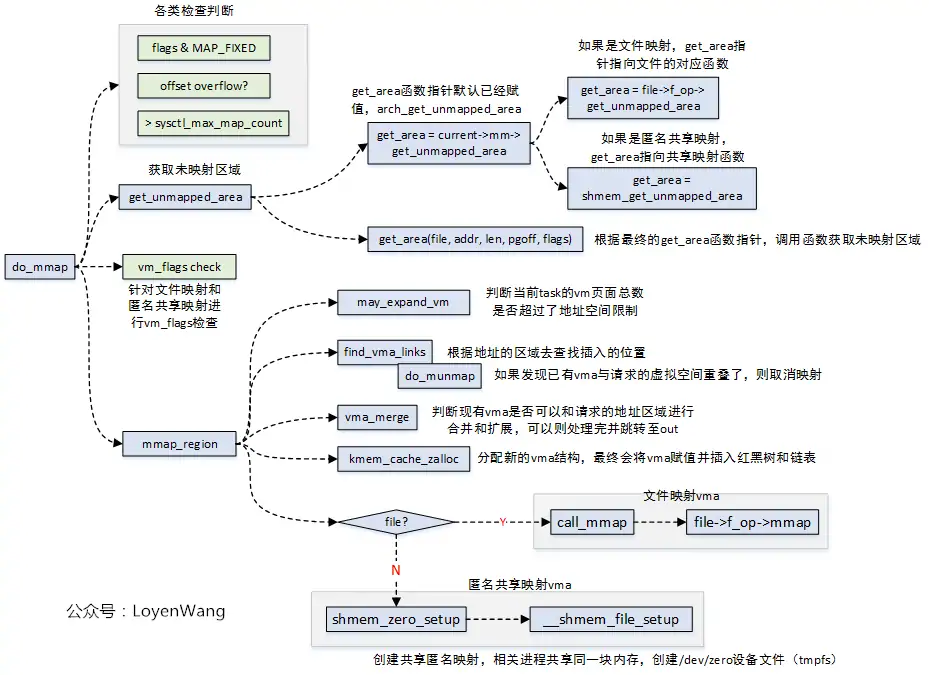
At this level, both malloc and mmap are doing address-space bookkeeping: create or extend VMAs, insert them into the process's VMA structures, and prepare the page tables. The physical pages often appear only on first access. That separation between virtual reservation and physical allocation is a central part of Linux user-space memory management.