CMS here means Content Management System.
Revision history
<table> <thead> <tr> <th>Version</th> <th>Change</th> <th>Date</th> <th>Notes</th> </tr> </thead> <tbody> <tr> <td>V0.1</td> <td>Created on an open-source program architecture platform</td> <td>2011-07-01</td> <td>Prototype design</td> </tr> <tr> <td>V0.2</td> <td>Changed the publishing feature</td> <td>2011-07-10</td> <td>Automatic filtering of styles, including links</td> </tr> <tr> <td>V0.3</td> <td>Changed the search results page and member center</td> <td>2011-07-15</td> <td>Unified experience</td> </tr> <tr> <td>V0.4</td> <td>Changed browser compatibility work</td> <td>2011-07-30</td> <td>Support across browser rendering engines</td> </tr> <tr> <td>V0.5</td> <td>Streamlined comments and publishing</td> <td>2011-08-08</td> <td>Simpler user operations</td> </tr> <tr> <td>Beta</td> <td>Added WebQQ APP integration</td> <td>2011-08-10</td> <td>Tencent open platform</td> </tr> <tr> <td>Beta</td> <td>Removed subsites and micro-updates</td> <td>2011-09-22</td> <td>Scope reduction</td> </tr> <tr> <td>Beta</td> <td>Added third-party account login</td> <td>2011-09-30</td> <td>To be continued</td> </tr> </tbody> </table>Project overview
Background
Micro World grew out of the overlap between film and television production and internet product thinking. A group of friends worked as writers and directors in film and TV. One member of the group also enjoyed film, sometimes joined productions, and worked in the internet industry. Those conversations repeatedly raised a question: how could the internet be used to expand film and television?
At a viewer event hosted by Wuxi TV, a talk covered how ordinary people can use the internet to improve themselves, including an idea for how ordinary people might participate in film and television creation. After the talk, the idea was broken down into a product concept and became Micro World.
The premise is simple: an individual has limited strength and limited creativity, while a Chinese saying notes that masters are often found among ordinary people. The team loves film and television and works with passion, but passion alone is not enough. Innovation is needed, and innovation is not something the team can complete alone. They wanted a platform that pools wisdom, invites hidden talent forward, taps the intelligence of internet users, and gives fans a home of their own.
The product moves from micro-scale, entertaining information sharing toward a targeted light-blogging plus micro-interaction platform. It manages fragmented information and supports relay-style, splice-style integration. Users co-create by connecting scattered plot points or continuing an outline; screenwriters later organize the result. The goal is an intermediate platform for gathering ideas. The concept was not just a notion but a complete product; similar campaigns had already been run by Zhubajie and Sina and were close to this idea.
Product goals
Early stage: a sharing platform. Micro World is a targeted sharing community where users share entertaining information. Its purpose is to accumulate data for later upgrades. It is a community for shared entertainment: enjoying together is better than enjoying alone. There is no high art and no vulgar spoofing; the focus is interesting life. Its slogan is Micro world, share classics. This reflects the micro-information character: short, interesting items that can be read without a second click. Compared with microblogging, it is more targeted, concise, and direct.
Middle stage: a self-service platform. The member center is migrated to a new platform, open platforms are connected, and services are integrated so users can receive services more conveniently and directly. A self-review mechanism is built, letting users decide what content is shared. A ratio algorithm pushes content to Micro World.
Late stage: an interactive platform and creation platform. The crowdsourcing ideas dream factory is completed, a film team joins, and users interact with the team to create film and television works. The result is a lightweight SNS platform: a fan interaction space for the team and an idea-exchange space for collaborative works.
Product roles
<table> <thead> <tr> <th>Role</th> <th>Description</th> </tr> </thead> <tbody> <tr> <td>System administrator</td> <td>Highest-level manager</td> </tr> <tr> <td>Information reviewer</td> <td>Can approve or reject information</td> </tr> <tr> <td>Member</td> <td>Has membership-level permissions</td> </tr> <tr> <td>Visitor</td> <td>Can read and publish anonymously</td> </tr> </tbody> </table>Product functions
Basic requirements
<table> <thead> <tr> <th>Requirement</th> <th>Description</th> </tr> </thead> <tbody> <tr> <td>Page encoding</td> <td>UTF-8</td> </tr> <tr> <td>Interface size</td> <td>960 px wide, centered</td> </tr> <tr> <td>Content publishing editor</td> <td>Must filter styles, especially hyperlinks</td> </tr> </tbody> </table>Module breakdown
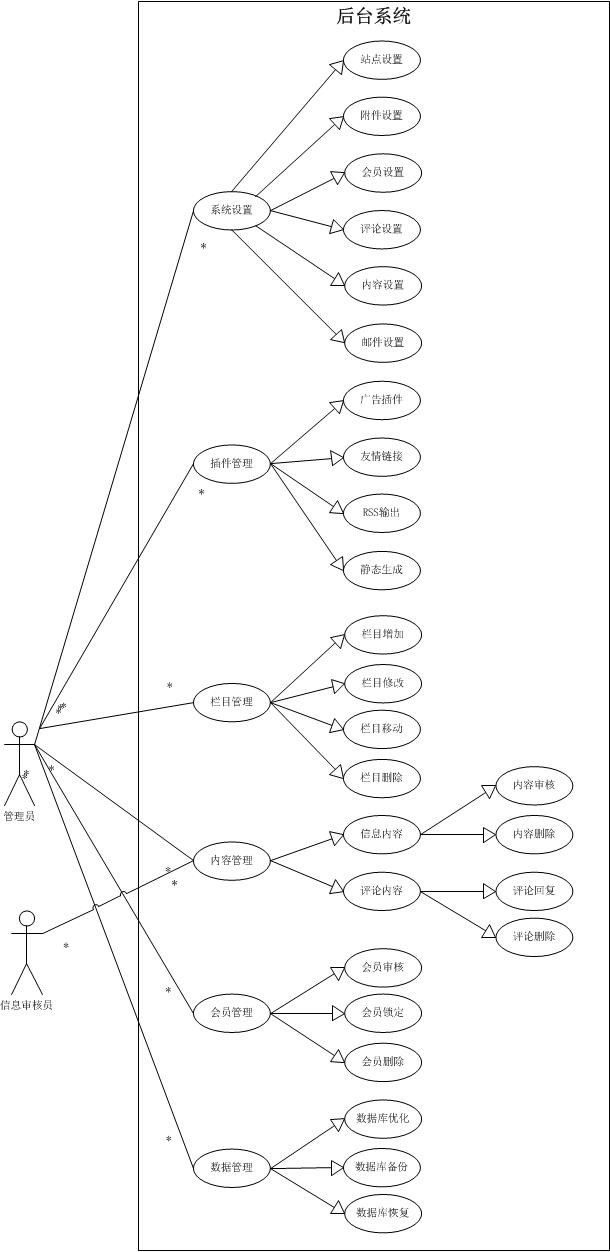
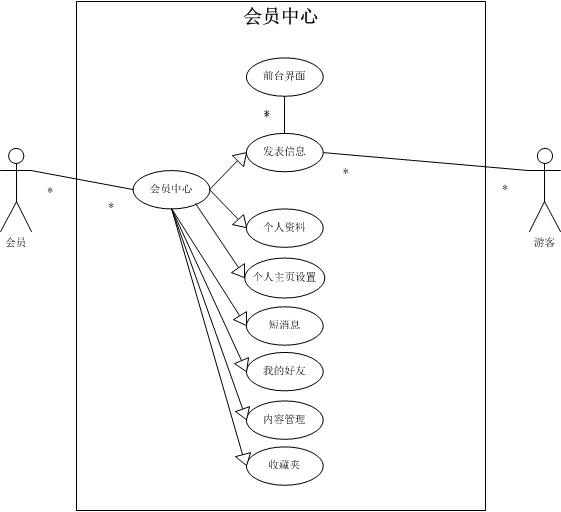
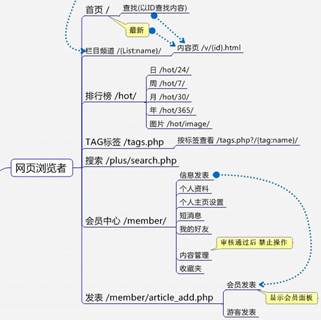
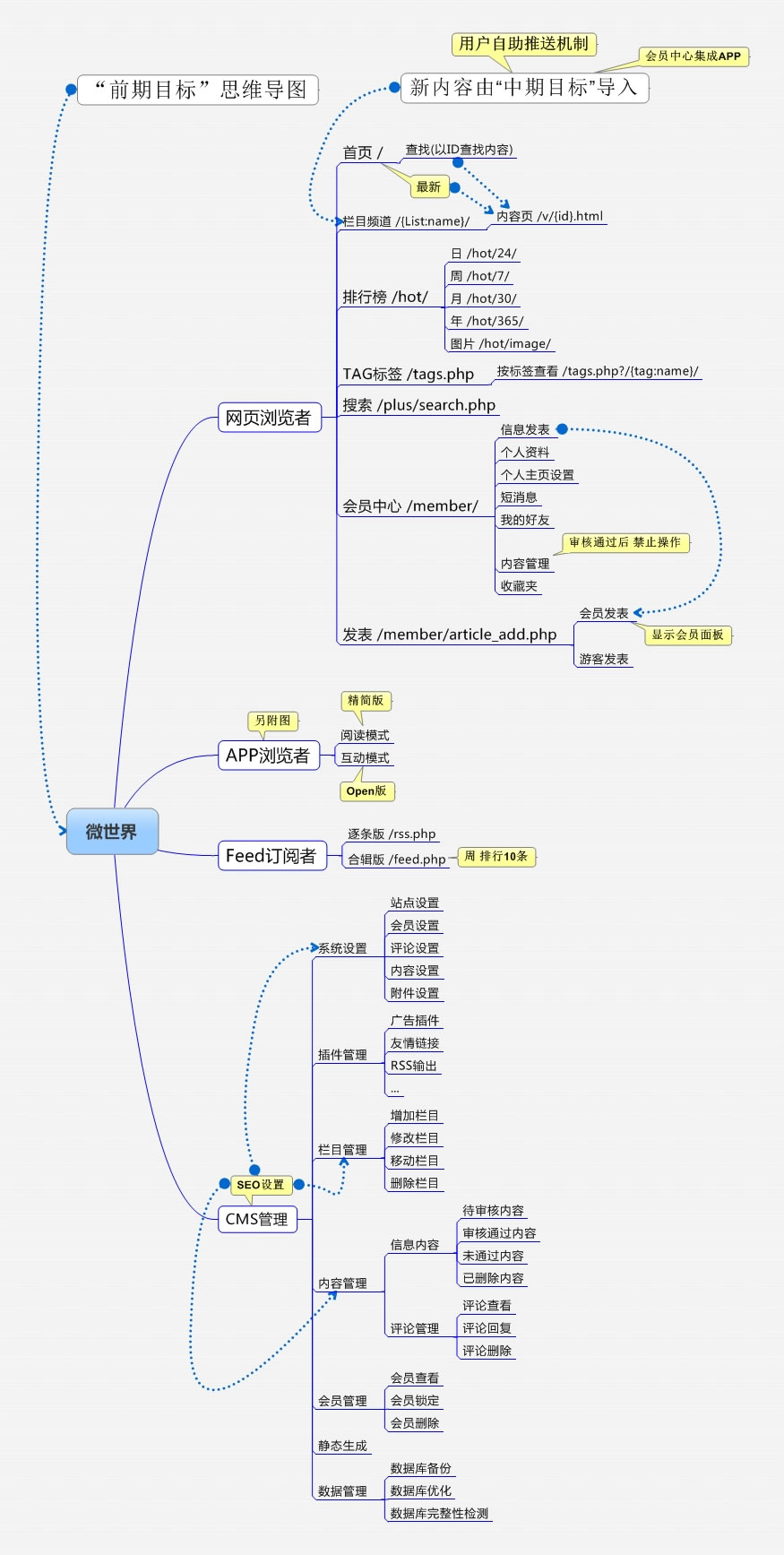
<table> <thead> <tr> <th>Module</th> <th>Description</th> </tr> </thead> <tbody> <tr> <td>System settings</td> <td>Site-wide settings management</td> </tr> <tr> <td>Plugin management</td> <td>Defines APP standards and provides interfaces for later expansion</td> </tr> <tr> <td>Section management</td> <td>Adds and deletes sections; section content templates are independent, following CMS practice</td> </tr> <tr> <td>Content management</td> <td>Reviews and publishes content; views, replies to, and deletes comments</td> </tr> <tr> <td>Member management</td> <td>Views members and sets permissions</td> </tr> <tr> <td>Data management</td> <td>Database backup, optimization, and checks</td> </tr> <tr> <td>Front member center</td> <td>Personal space</td> </tr> <tr> <td>Front publishing</td> <td>Information sharing</td> </tr> <tr> <td>Front search</td> <td>Content search and full-text checks</td> </tr> </tbody> </table>Module design
Product model
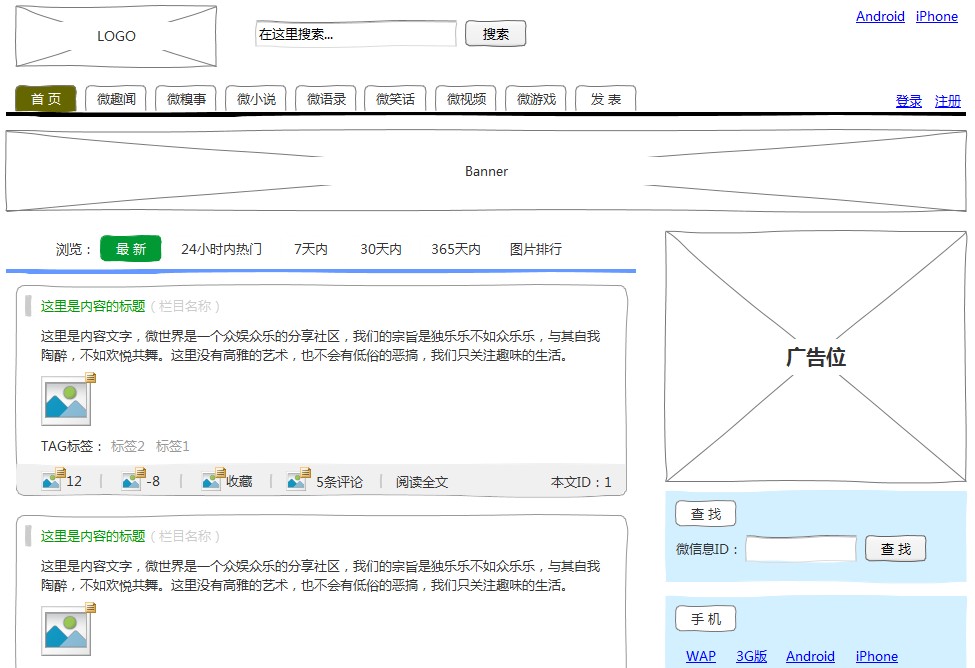
Product use cases
Use cases were planned as a separate document.
Product requirements
At the Beta PRD stage, detailed requirements were still to be defined for software and hardware environment, operations, security, product upgrades and maintenance, interfaces, and other areas.