October signed off with a full week of rain.
Life: saying goodbye to October
The last week of the month was basically one long stretch of stormy weather. In the middle of it, a college friend I hadn’t seen in ages came to Boston for a visit and, of course, arrived right in the middle of the downpour. Still, we managed to get a meal together, and that alone made me happy.
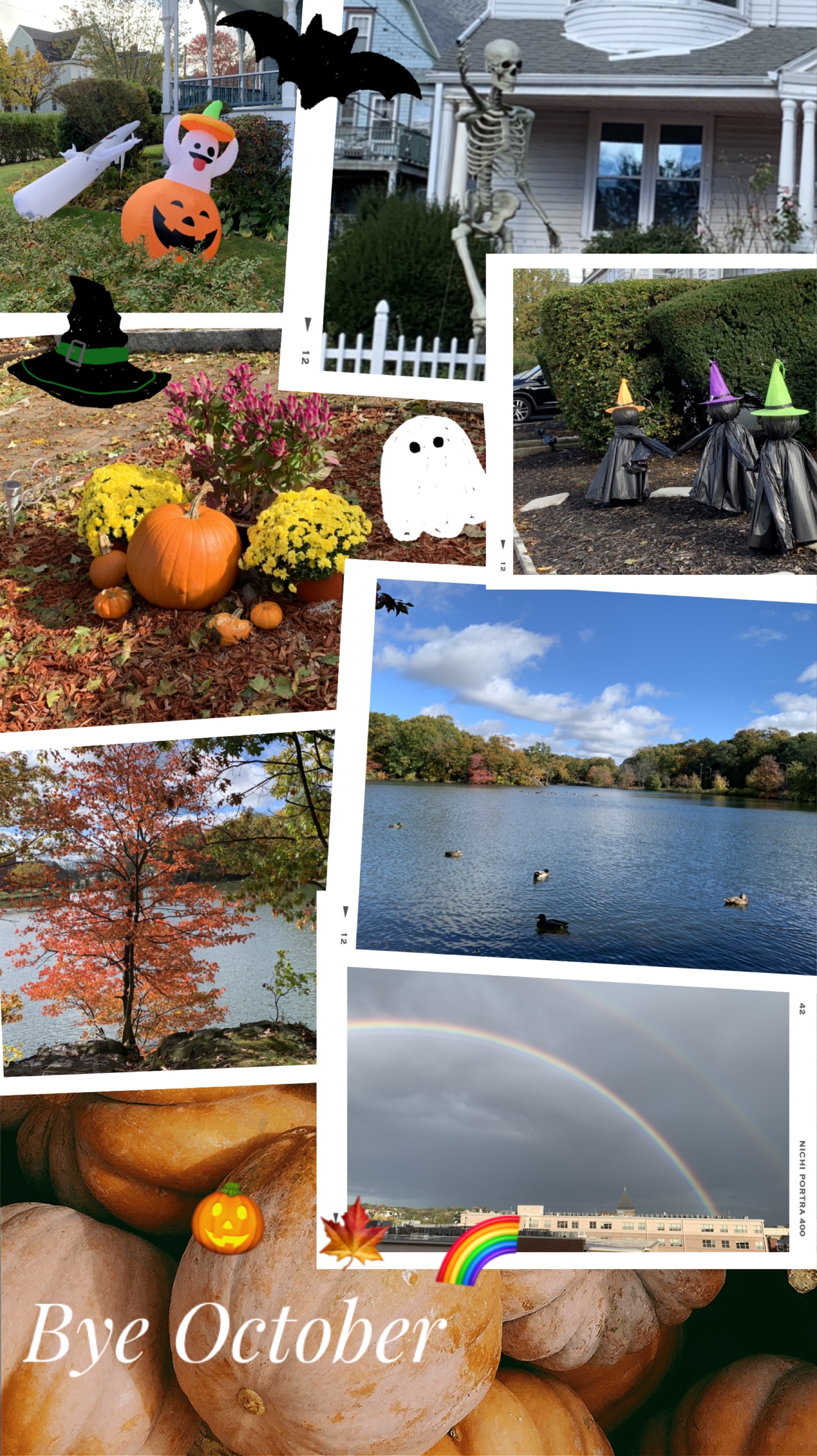
By Sunday the sky had finally cleared. It was also Halloween, so I went out for a walk hoping to admire the neighborhood decorations. My neighbors, apparently, were not especially in a festive mood this year—there were only a few scattered decorations here and there—but it was still fun to wander around. Even without many spooky displays, the post-rain air felt incredibly fresh, and the autumn atmosphere was strong. After barely going outside for a week, that walk honestly felt like a recharge.
Back home, I looked out the window in the afternoon and saw a rainbow—actually a double rainbow. Huge, bright, and perfectly clear. A very literal case of “no rainbow without the rain.”
Documentary: World War II in Colour
I thought this was a very solid series. Each episode focuses on a specific topic or event rather than moving neatly through the war in chronological order, so the timeline can feel a little fragmented. It also centers mostly on the European theater, which gives it a certain bias and makes it less ideal if you are trying to build a complete overall picture.
Even so, I learned a lot from it. For someone like me, who came in with a fairly thin grasp of the details, it gave much more texture to things like the Dunkirk evacuation, the attack on Pearl Harbor, and the Normandy landings—events that had previously existed in my head more as historical labels than lived realities.
What struck me most was, again, how horrifying war is. From a distance, history tends to condense everything into campaigns, strategy, technology, and victory. But behind all of that are individual human lives. The most affecting parts of the series were the images of victims and the interviews with veterans and survivors. You watch something like that and want to believe humanity can learn from it, though it is hard to feel very optimistic.
Film: The Matrix
The fourth Matrix film was due out that December, and somehow I had still only just gotten around to watching the first one. Mostly this was because I’m a coward and had been oddly intimidated by it for years. Recently, though, I had been following a weekly Matrix commentary series that was excellent, so I finally sat down to watch the movie itself.
Because I had already seen a lot of analysis, I went in with plenty of expectations and probably a lot fewer surprises than I otherwise would have had. Even so, I liked it quite a bit. What I especially enjoyed were some of the more “Zen”-like ideas running through it—I found that part really interesting. I’m planning to watch the next two films as well.
Anime: Cowboy Bebop
I finally finished Cowboy Bebop, which I had been slowly making my way through since August. So many friends had spoken of it with near-reverence, but for some reason I never quite connected to it in the same way, which is probably why it took me so long to finish.
At a basic level, it’s about bounty hunters in space chasing down criminals, while the story gradually reveals each character’s past and the wounds they carry. The relationships among the crew are built on a kind of mutual understanding that also involves not asking too much about one another’s histories. That dynamic, for me, was a little hard to fully get behind. I kept thinking: wouldn’t it be better if everyone were just a bit more honest?
A friend told me this is probably because I was projecting too much of my own real-life preferences onto the characters, which is honestly fair. So no, I didn’t end up loving it as much as some people do—but I definitely don’t regret watching it. And the soundtrack really is fantastic.
Videos: Young People’s Concerts, Episodes 20 and 21
Episode 20: The Sound of a Hall
In this episode, Bernstein talks about concert hall acoustics—what makes a hall sound good, and how different acoustic qualities shape the listening experience. He explains several key ideas and demonstrates each with examples.
The qualities he discusses include reverberation, that lingering resonance after a sound; intimacy, meaning that the audience should feel as if the music is close at hand, illustrated with Aaron Copland’s The Little Horses; clearness, or whether you can distinctly hear the different instruments, with Vivaldi’s Concerto for Four Violins as an example; blending and texture, which concerns how instrumental sounds combine, demonstrated with Walton’s very fun Facade Tango; and dynamic range, meaning whether a hall can still sound good at very different volume levels, for which he uses Tchaikovsky’s 1812 Overture.
What makes the episode even more interesting is the timing. It aired about a year after the New York Philharmonic had moved into Fisher Hall at Lincoln Center, now called David Geffen Hall. The acoustics at the opening were notoriously bad, which is especially ironic because the hall had been promoted as a triumph of scientific acoustic design. It improved only after a great deal of acoustic adjustment. And after looking into it a bit, it seems the tweaking didn’t stop there: many more rounds of changes followed, and another improvement plan was announced again in 2019. The “curse” of Fisher Hall’s acoustics really may have lasted for decades.
Episode 21: What is Melody
This episode takes up a deceptively simple question: what is melody?
Melody is obviously one of the central elements of music. If you define it simply as a sequence of notes unfolding in time, then it becomes hard to imagine any music without melody at all. And yet people constantly say things like, “This piece isn’t very melodic.” Bernstein’s point is that melody comes in many forms. It can be a tune, a theme, or a motive. It can appear in the top voice, an inner voice, or the bass. It can be obscured by complex counterpoint and become harder to identify immediately. So when people say something lacks melody, what they often mean is that it lacks a certain kind of memorable tune in the upper voice.
In symphonic music, as Bernstein had argued before, development is often more important than tune. A tune in the familiar sense can feel too complete, too self-contained, and therefore harder to develop further. He ends up suggesting that our sense of whether something is “melodic” depends heavily on what our ears expect—in other words, on taste.
He gives a personal example: when he was younger, he couldn’t really appreciate the endless, flowing beauty of the melody in the second movement of Bach’s Italian Concerto. At the time, he was more drawn to melodies with obvious repetition. With age and a deeper understanding of music, he came to hear that Bach passage differently. From there he expands the idea outward: just as individual taste develops, so does historical taste. Music once dismissed as not melodic at all may later come to be heard as a great example of melody.
It was a great episode overall, full of examples as usual. He also mentions a very common melodic pattern—1-2-3—where 1 introduces an idea, 2 repeats it with a slight variation, and 3 takes off. A simple idea, but a fun one.
Video: The failed utopia of the creative class
The last thing I wanted to mention this week is a video by Alice on the idea of the “creative class,” a term associated with the economist Richard Florida. Very roughly, the concept groups together people who create value through “creativity” and argues that post-industrial regions increasingly depend on this class for growth. It also feeds into all sorts of discussions about how cities can make themselves more attractive to such people.
In the video, Alice critiques the concept directly, asking what creativity even means in the first place and looking at how much harder it has become to clearly say what class one belongs to in the present moment. I’m probably not doing the argument justice here, but I found it genuinely thought-provoking and learned a lot from it.
Quote
You become what you give your attention to. If you yourself don’t choose what thoughts and images you expose yourself to, someone else will .. and their motives may not be the highest. (Epictetus)