Let me start with a small neighborhood farce. A few days ago, a false alarm shook the compound where I live. Soon afterward, the property management company posted an explanation on its WeChat Moments feed. It took the form of an open letter to residents—apparently the least effective method available on that channel, and also the only one. The letter circled the issue without landing on it. It offered the kind of story a screaming match offers: feelings, hardship, how hard the job is, how misunderstood everyone is. It never named the concrete problem, let alone proposed a fix for the problem it had just exposed.
The structure was familiar. Medical workers are exhausted because residents will not make things easy for them. The virus keeps coming back because residents will not confine themselves according to the rules. How long the restrictions will last? No answer. Between the lines there was one standard: we can talk when you obey.
By then, lockdown rules had become deliberately vague. There was no clear threshold for closing or opening. That vagueness lets responsibility slide down to the lowest level, until residents are said to have voluntarily locked themselves in. If that does not work, stir up those who fear the virus against those who do not take it seriously. Once residents restrain each other, the number of people who need managing is cut in half. This is one of political science’s more interesting readings of power. Why half? Because half is enough.
The property notice and the letters that official platforms kept sending to residents share the same logic: appeal to feelings, excite emotion, and aim, in the end, at halving the managed population.
Bentham’s circular prison
In 1785, the British philosopher Jeremy Bentham proposed a design for a prison system. Yes, the prison system was a philosophical topic even then. More than two centuries ago, philosophers were already fluent in the rules of future society. Bentham’s panopticon was never really about prisons as such. It was a complete blueprint for a future society.
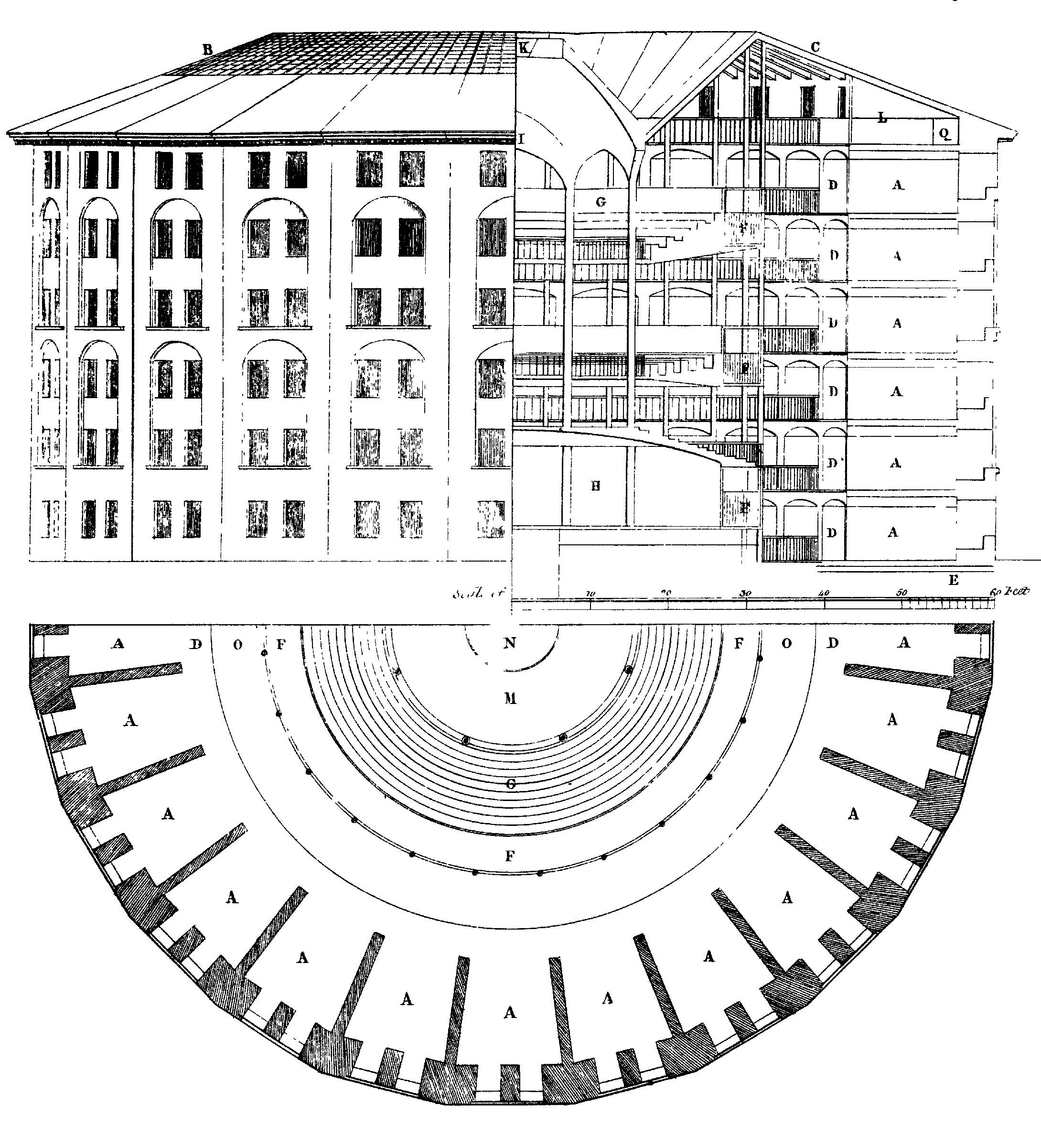
Put simply, the panopticon places a watchtower at the center of a circle. The cells are arranged around it, with louvered windows facing inward. From the tower, guards can easily observe every move in every cell. From the cells, inmates cannot see whether anyone is in the tower. The uncertainty makes them suspect that they are being watched at all times. They live in constant dread. The design reduces the number of guards required.
A new form of surveillance, whose power is unprecedented.
— Jeremy Bentham
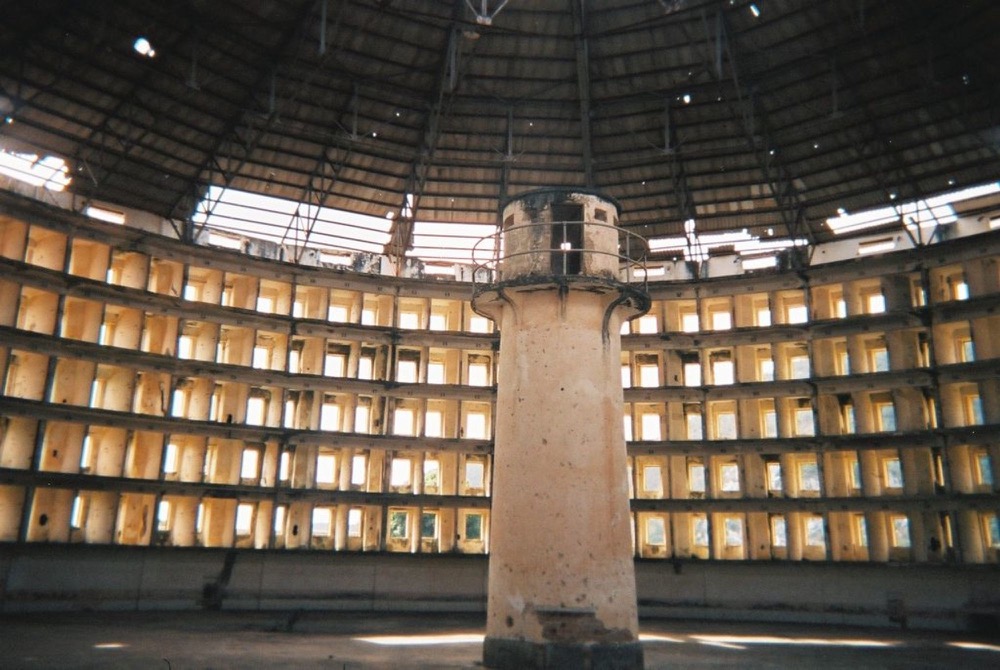
The New Gerona Prison on Cuba’s Isle of Youth used this design. Whether it proved the prison system workable is another question—it was decommissioned in 1967. In fact, I have always thought the panopticon is not a plan for a prison system but a curious set of social rules. It can push the managed population toward being halved, or even toward losing its status as managed altogether, producing a kind of absolute management.
I am not an absolutist, but when it comes to the construction of the panopticon, I think it comes close to achieving the absolute. Of course, the more absolute something tries to be, the more likely it is to meet a black swan and collapse entirely. That is the two-sided nature of the thing.
The original aim of the panopticon is to manage the largest possible number of people at the lowest possible cost in managers. In an ideal state, one person in the watchtower could monitor the entire prison—but only if the inmates have internalized the belief that the tower is watching their every move. They must form a kind of self-surveillance. The ideal social operation, then, would be this: without any managers at all, the maximum number of managed people surveil themselves.
If that is the case, then as a group-social black swan, you have already found the way to break the rules. You show people the truth of the panopticon. You make them realize that the surveillance is only ideal, that they can exploit the system’s blind spots along the diagonal of the circle and trigger an escape, forcing the watchtower’s attention to scatter. There are countermeasures to this countermeasure. I once worked them out in a novel I wrote in a single day called Prisoner’s Conjecture. But that is a later story.
So the ideal panopticon has many holes, and all of them can be exploited by a black swan. That is why the method of halving the managed is needed as insurance. Halving the managed is my shorthand for reducing the number of managed people by half, thereby reducing the risk that they slip out of management. It combines the philosophical panopticon with another theory from the world of economics.
Drucker’s seven
That other theory comes from Peter F. Drucker, the father of management, who in 1945 introduced the concept of the span of control. The span of control is the total number of people, money, and things that one manager can manage at maximum capacity.
Put simply, Drucker suggested that one person’s span of control should not exceed seven people. Seven department heads report to one owner. Arranged that way, it is easier to understand how projects are running and to make quick adjustments and decisions about the company’s direction.
This is not absolute scripture. Google, for example, has a span exceeding twenty people. Apple under Steve Jobs even used a Top 100 structure: one hundred core members reported directly to Jobs. The panopticon, proposed back in 1785, can reach ratios of 1:1000 or more. Why can the span of control be so large? It depends on the depth of management. The panopticon uses direct management—a flat structure. It feels strange to describe Apple’s flat structure through a prison, but it is also oddly apt. Inmates take responsibility for their own behavior, and the watchtower decides whether to punish or tolerate what it sees.
My job is to work with the Top 100.
— Steve Jobs
Other, stranger organizations have very messy vertical depth. A command issued at the top may pass through more than a dozen approval gates before it reaches the bottom. Are those gates useful? Obviously they are, because they redistribute responsibility. Each layer avoids carrying blame for its own failures, and responsibility gets passed along. That is why rules pile up layer after layer. As vertical depth grows, horizontal span shrinks, and eventually you are left with the seven-person position again. So do not underestimate the number seven. It is quite magical. That too is a later story.
In a seven-based hierarchy, the first level manages seven people. The next level manages seven squared, or forty-nine. Then seven cubed, or 343. If every manager at every link only manages seven people, the structure can extend to a much greater depth. That is still the ideal state, of course—because the black swan is this: if one-seventh of any level collapses, and that person is closer to the center of power, the destruction is greater.
How to halve a neighborhood
Now suppose we halve the managed.
Residents in the compound are unhappy with the property managers and disease-control staff over lockdown measures. The managers are few. How do you manage the whole compound? Simple: create internal friction. Let half the people fear the virus. Let the other half not fear it, then pin on them the accusation that they do not care about other people’s lives. The fearful half will spontaneously begin managing the other half. The managed population is halved: one half is held in check, and the other half has become inmates who have internalized the panopticon and now police themselves. You can also call it self-castration.
Then give the restrained inmates a little power. Make them ten-household heads or volunteers. Let them see that obedience can be exchanged for the exercise of power. The halved managed population is layered again beneath these temporary managers, splitting off another ring of management.
Look at it this way, and what is the essence of power? I have spent this whole piece trying to hide the word, and then I let it slip. It is the standard answer to the question.
Work backward. If the ten households under a ten-household head ignore that head’s arrangements and overturn his rules, has his power not been lost? If the ten-household head, after months of lockdown, never receives the promised special supplies and falls out with the property management company, he stops exercising his power too. The ten-household system inside the compound then tends toward collapse. Property management, attacked from front and back, flips. It says the unreasonable lockdown is the result of a one-size-fits-all order from the subdistrict office, and turns into a spokesperson for the managed.
I can only go that far. Any further and I would be wandering into forbidden territory.
The essence of power is obedience. It is that simple. It is that fucking simple.