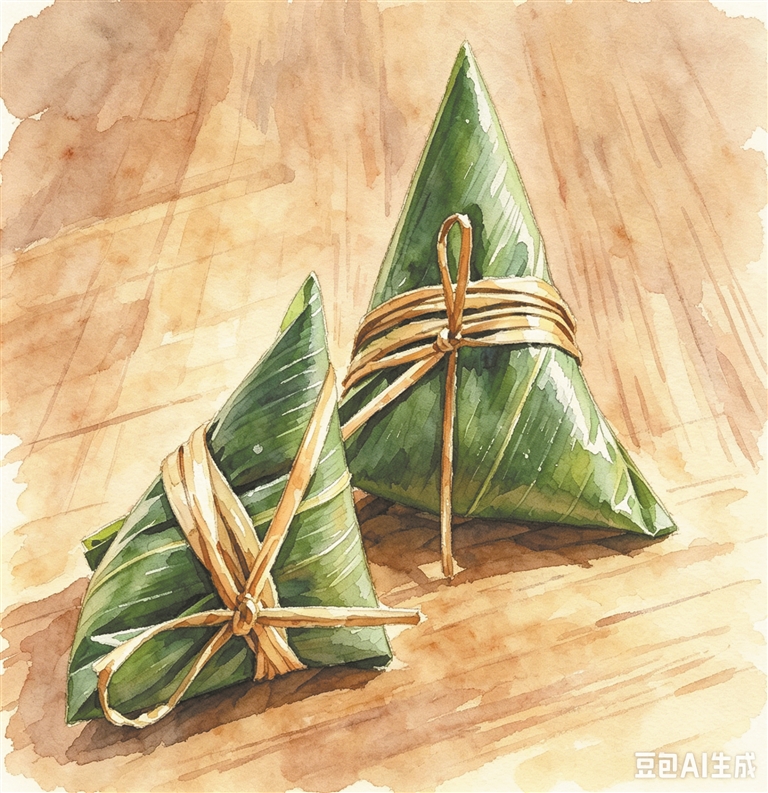
My father didn't talk much when he wrapped zongzi, but he was meticulous. He would lay two bamboo leaves across his palm, curl his fingers to shape them into a cone, scoop in a spoonful of glutinous rice as a base, scatter a handful of red beans on top, press a red date into the middle, then fill it with more rice and smooth the top. Finally, he folded the leaf tips over to seal the opening, freed one hand to pull the five-colored string—the string wound around his fingers, three loops, a knot, and a hard tug. The zongzi stood firm on the table, the string pressed deep into the leaves, leaving a visible groove.
I watched him work so smoothly and tried to copy him: roll the leaves, add rice, stuff the date, fold the edge, pull the string. But when it came to tying, my hands wouldn't cooperate. I looped the string twice, loose and sloppy, and grains of rice squeezed out through the gaps, pattering onto the table. I added another loop—still loose. Frustrated, I yanked hard. Snap. The string broke, the leaves sprang open, glutinous rice scattered everywhere, and the red date rolled under the table, spinning twice before it stopped.
Father stopped. He picked up the collapsed zongzi, added rice and date again, folded the leaves.
"Here, watch me."
He showed me the tying in slow motion: one loop, pull tight; a second loop, pull tight again; a third loop to finish, then knot it.
Then he handed me the string. "Now you try."
I made another one. This time the string didn't break, but I was nervous it would come apart, so I wrapped it four or five times, until the zongzi looked like a wounded sparrow.
Just as I was about to put it in the pot, Father picked it up, looked at it, and said only: "Tie it again. If it's not tight, how can it work?"
I talked back: "Close enough is good enough, isn't it?"
Father said sternly: "If a zongzi isn't tied tight, it leaks when you boil it. Same as being a person—if you do things carelessly, sooner or later you'll leak."
I was about eight or nine then. I half understood, but mostly felt wronged—I had wrapped it, hadn't I? Why was it "not reliable"? But I didn't argue anymore. I kept my head down and made two more. By the third, I finally produced a decent one, the string pulled tight, the leaves stretched shiny, like a well-fitted little jacket.
Father said nothing this time. He put those zongzi into the pot.
"Tie it tight, or it leaks when you boil it." I've remembered that sentence for thirty years. Later, I read a saying: "In all things, preparation leads to success; without it, failure." It means you have to prepare in advance and make things solid, or they won't work out. I immediately thought of my father's "tie it tight, or it leaks"—wasn't that just the plain-spoken version of "without preparation, failure"?
My father couldn't say fancy words like "preparation leads to success," but with one zongzi and one piece of string, he tied that lesson firmly into my heart. Whenever I do something, write an article, or make a promise to someone, I unconsciously ask myself: Have I tied this zongzi tight?