Imagine two ways of investing in U.S. equities:
- Blue strategy: buy a U.S. stock ETF at the 4:00 p.m. New York close, sell it the next morning right at the 9:30 a.m. open, then wait until the next close to buy again.
- Green strategy: do the reverse—buy at the open, sell at the close, and repeat every trading day.
According to long-run data compiled by a site focused on so-called abnormal overnight returns, the total return of these two approaches since 1994, ignoring transaction costs, looks roughly like this for the S&P 500 ETF SPY:
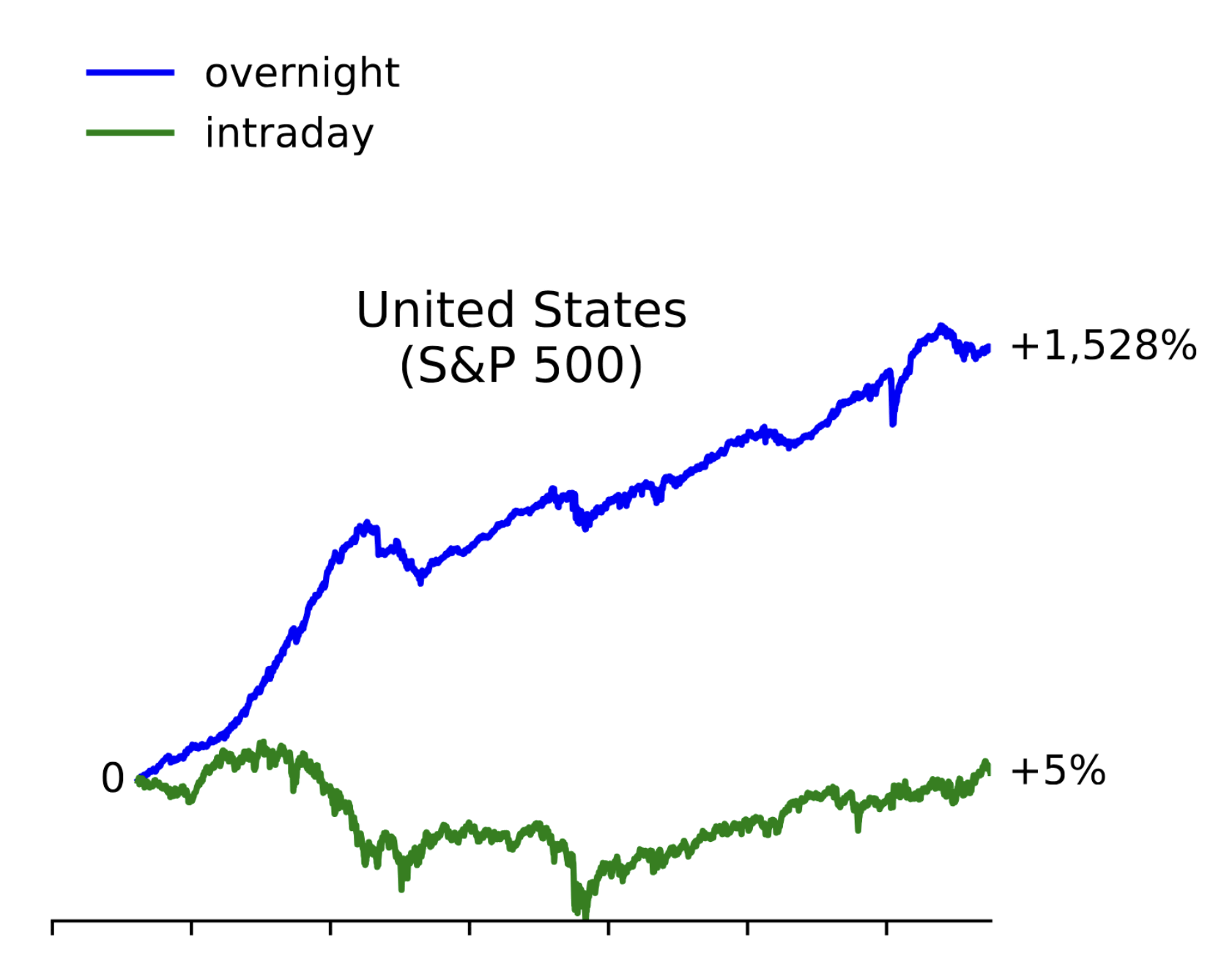
That gap is so large that it immediately raises a question: why would holding stocks during the day and holding them overnight produce such dramatically different outcomes?
There are a few ordinary explanations worth considering first.
First ordinary explanation: one strategy may be leaving money idle
Before comparing the two, it helps to remove an obvious distortion: unused cash should not be treated as earning nothing. In finance, idle capital is usually assumed to at least earn the risk-free rate—in other words, money that is not invested in stocks should be parked somewhere safe and interest-bearing.
The risk-free rate is the theoretical return on an investment with essentially no financial risk. In practice, instruments that come closest are things like overnight lending rates or short-term government debt issued by countries with strong credit and monetary sovereignty, such as U.S. Treasuries.
So the fairer comparison is not the original pair of strategies, but these adjusted versions:
- Blue+: keep the money in the bank during the day, hold stocks overnight
- Green+: hold stocks during the day, keep the money in the bank overnight
Because bank interest is calculated overnight, Green+ gets that interest and Blue+ does not. That means if neither strategy parks cash in the bank, then the original blue strategy is effectively the same as Blue+, while the original green strategy underperforms Green+ by exactly the foregone risk-free return.
Unless there is some risk-free place to earn a daytime yield instead, the green side is automatically at a disadvantage.
And how large is that disadvantage over the relevant period? A rough estimate for cumulative inflation from 1994 to 2025 comes out to +118.61%. If long-run risk-free returns roughly track inflation, then even after making this correction the gap is still enormous: Blue+ is about +1,528%, while Green+ is only +118.61%.
So idle cash cannot explain away the difference.
Second ordinary explanation: overnight is much longer, and riskier, than trading hours
Another straightforward factor is exposure time.
Using New York Stock Exchange hours as a reference, the market is open roughly 250 days a year for 6.5 hours per day, or about 1,600 trading hours annually. By contrast, the market is closed for more than 7,100 hours per year.
That matters because companies tend to release major announcements—especially earnings—after the close, not during active trading hours. So the blue strategy is exposed to far more time and far more event risk than the green strategy. Higher return would not be surprising if it is compensation for bearing that additional risk.
So far, so normal.
But the global pattern is where the ordinary story starts to break down
Everything above refers to the U.S. market. The more unsettling question is whether the same pattern appears elsewhere.
Using the cross-market chart from overnightreturns.org:
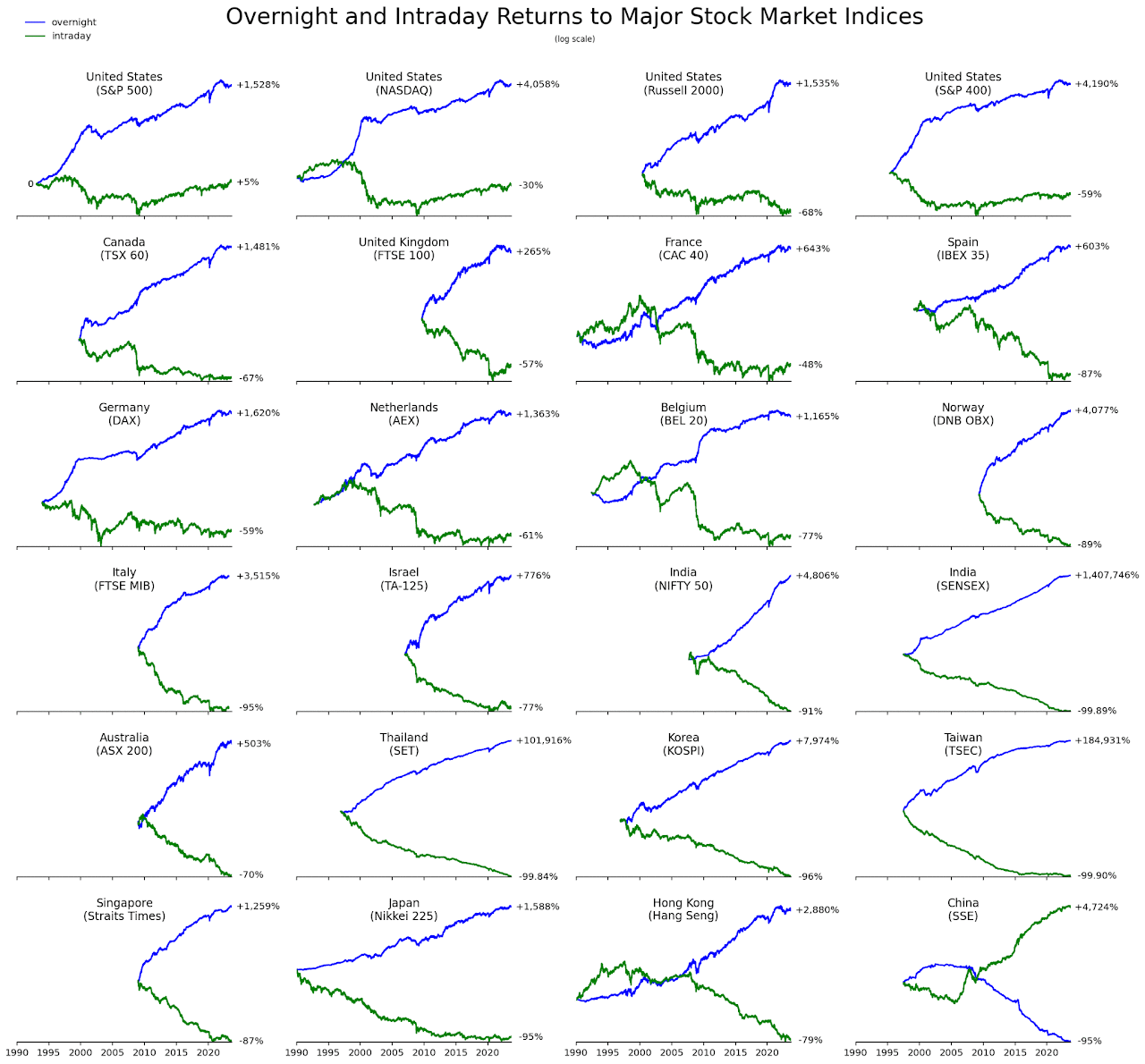
This is where things start to look bizarre. In most markets, the green strategy—holding only during the day—does not merely lag. It appears to grind down toward wiping out almost all capital.
That is hard to reconcile with the ordinary explanations. Yes, overnight exposure is longer than daytime exposure, so one might expect larger gains or losses there. But if that were the full story, the two return series should at least broadly move in the same direction over time. Instead, many markets show a persistent pattern of daytime underperformance so severe that something else seems to be happening.
And there is another awkward detail: holding overnight is actually disadvantaged around dividends, because on the ex-dividend date the price typically drops overnight by the amount of the dividend. So overnight returns are not being flattered by some hidden dividend accounting trick.
After turning this over from every reasonable angle, one possible explanation keeps forcing itself into view:
information leakage.
What would “information leakage” mean here?
If a pattern this abnormal persists for decades, then at least one of the following must often be true:
- The opening price is above fair value
- The closing price is below fair value
Only under those conditions can the green strategy repeatedly buy high at the open and sell low at the close, year after year.
The second possibility—closing prices below fair value—can partly fit the earlier risk-based explanation. Investors may demand a discount before holding through a period when they cannot trade and when black-swan news might hit.
But that cannot easily explain some of the more extreme examples. In markets such as Thailand and Taiwan, the contrast between overnight and intraday returns appears extraordinarily steady across decades, with surprisingly little noise. It is difficult to believe that plain old risk aversion would generate something that smooth and persistent.
So attention naturally shifts to the first possibility: opening prices are systematically too high.
Who buys at the opening price? Among others, investors who place orders after the market has already closed. Those orders cannot execute immediately, so they sit with brokers and wait to be sent to the exchange when trading resumes.
That raises an uncomfortable question: what can intermediaries do with the information contained in those queued orders before the open?
One thing, surely, is beyond doubt: brokers are perfectly honest, would never sell order information to anyone, and would never push prices against their own clients. If clients lose money, it must just be incredible bad luck—bad luck so consistent that it repeats for thirty years. 👻
The sarcasm is hard to avoid.
Why the S&P 500 looks less extreme
One feature of the chart stands out: the U.S. S&P 500 looks noticeably healthier than many other markets.
A plausible reason is that the S&P 500 has a very liquid overnight futures market.
Liquidity means an asset can be bought or sold quickly without causing a large price move. In a liquid market, there are enough buyers and sellers that trades can happen fast at reasonable prices.
Futures markets have an important structural advantage here: they are naturally two-sided. Participants can take long or short positions much more symmetrically than in many cash equity markets. The technical details are not the point. What matters is that if someone spots a pricing distortion overnight, futures make it possible to arbitrage that distortion quickly instead of waiting helplessly until the stock market reopens.
That kind of around-the-clock price discovery may help prevent some of the more extreme opening mispricings seen elsewhere.
None of this is a pitch for day-trading the close and open
These observations are not an argument for mechanically buying at the close and selling at the open every day. In the real world, transaction costs, fees, spreads, and market impact would eat a strategy like that alive very quickly.
The more important point is structural. When markets are closed for long stretches, brokers or other actors with access to order flow may gain opportunities to extract unfair profits from information asymmetry. A better defense is not clever retail timing but better market design: deeper and freer trading mechanisms, including robust overnight futures trading and potentially more continuous spot-market price discovery.
Let markets police markets.
For ordinary long-term investors, there is not much practical advice to take from this beyond one simple thought: if you are not constantly trading—and you should not be—then the exact time of an occasional buy or sell is unlikely to make a meaningful difference to your long-run return.
Still, there is one modest habit worth keeping: try not to place stock orders after the market has already closed. If nothing else, it is one small way to make life a little harder for anyone feeding off that informational edge.