In January 2026, Addy Osmani offered a line that sounds almost too neat to be true: '90% of Claude Code’s code is written by Claude Code itself.' The number is striking, but its real significance is not a clever statistic. It points to a different kind of story: not AI helping people write software, but AI participating in the creation of its own implementation. The AI agent world has a name for this pattern: bootstrapping.
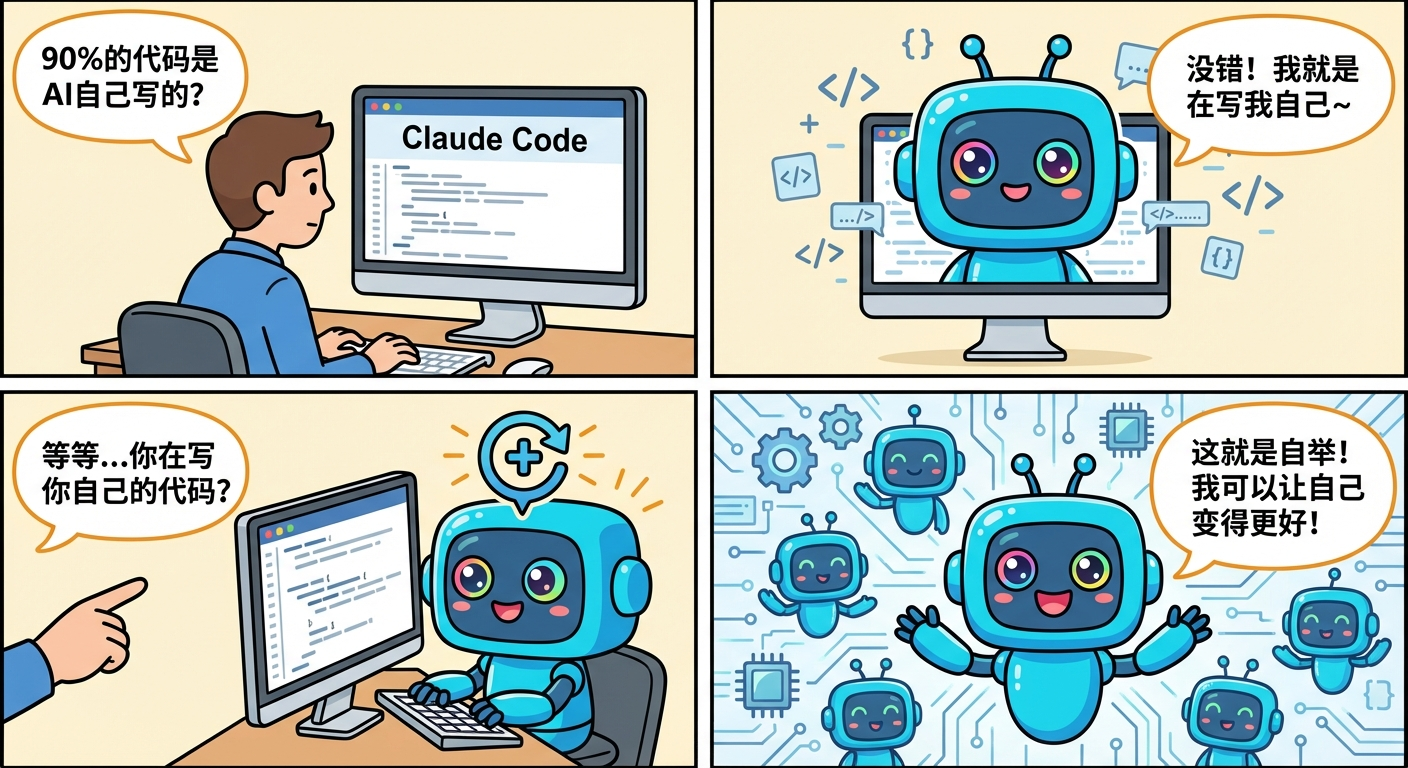
Bootstrapping is an old idea in computing, and compilers are its classic example. The first C compiler was written in assembly. That compiler was then used to compile a C-language version of the compiler’s source code. After that, the C compiler could compile itself. The specific sequence matters less than the principle: once a system has a basic version of a capability, it can use that capability to improve itself.
Claude Code’s self-written code is a new version of that principle. The subject has shifted from a compiler to an AI agent. The recursive loop is no longer only about translating source code into machine instructions; it is about an AI system helping to build and refine the system that runs it.
Osmani’s account is not a story about handing over a codebase and walking away. His workflow for AI-assisted engineering in 2026 rests on three conditions.
The first is clear direction. AI should not be treated as a magic wand. Someone still needs to know what is being built and why. Humans set strategy; AI operates at the tactical level.
The second is rich context. Through MCP, the Model Context Protocol, an AI system can connect to external knowledge sources: code repositories, documentation, API specifications, databases, cloud services, test suites, deployment scripts. The point is to keep Claude Code from guessing. It should reason against the actual architecture and history of a project, not just the snippet in front of it. This also encourages a more AI-native way of organizing code, where the structure is legible to both people and agents.
The third is ongoing supervision. AI writes code; humans orchestrate. Code review and test validation remain human responsibilities. A figure like 90% AI-written does not mean zero human involvement. It means the balance of labor has changed, not that accountability has disappeared.
Osmani’s conclusion is not that engineers become unnecessary. It is that a new kind of engineer emerges: the AI-native software engineer, someone who knows how to collaborate with AI and get the most out of it.
Not every AI coding tool can reach this point. Claude Code’s bootstrapping claim depends on several technical choices.
MCP gives the agent a way to connect with the wider project environment. It can read code, documentation, and API definitions. It can reach databases and cloud services. It can run tests and deployment scripts. This turns code generation from an exercise in plausible-looking text into reasoning grounded in a real system.
Claude Code also uses a subagent architecture. A main agent handles orchestration while subagents focus on narrower tasks such as searching, file operations, or testing. These agents can work in parallel. The bootstrapping twist is recursive: Claude Code uses its subagent architecture to write code for subagents. That creates a feedback loop in which the system’s own structure becomes part of what it can improve.
Long context and project-level understanding are the third ingredient. A model needs to hold enough of a project in view to preserve cross-file consistency, understand architecture, and carry out large refactors without breaking logic. Without that global view, generating more code can produce local improvements that never add up to a working system.
The broader arc of AI coding has moved through several phases, and Claude Code’s self-written code is meant to mark a later one. The compiler analogy is useful here because bootstrapping has long been a sign of technical maturity. Once a compiler can compile itself, language developers can use the language to strengthen the language. Bug fixes and feature work can move faster. AI agents may follow a similar path: fixing their own bugs, implementing new capabilities, and accelerating their own evolution.
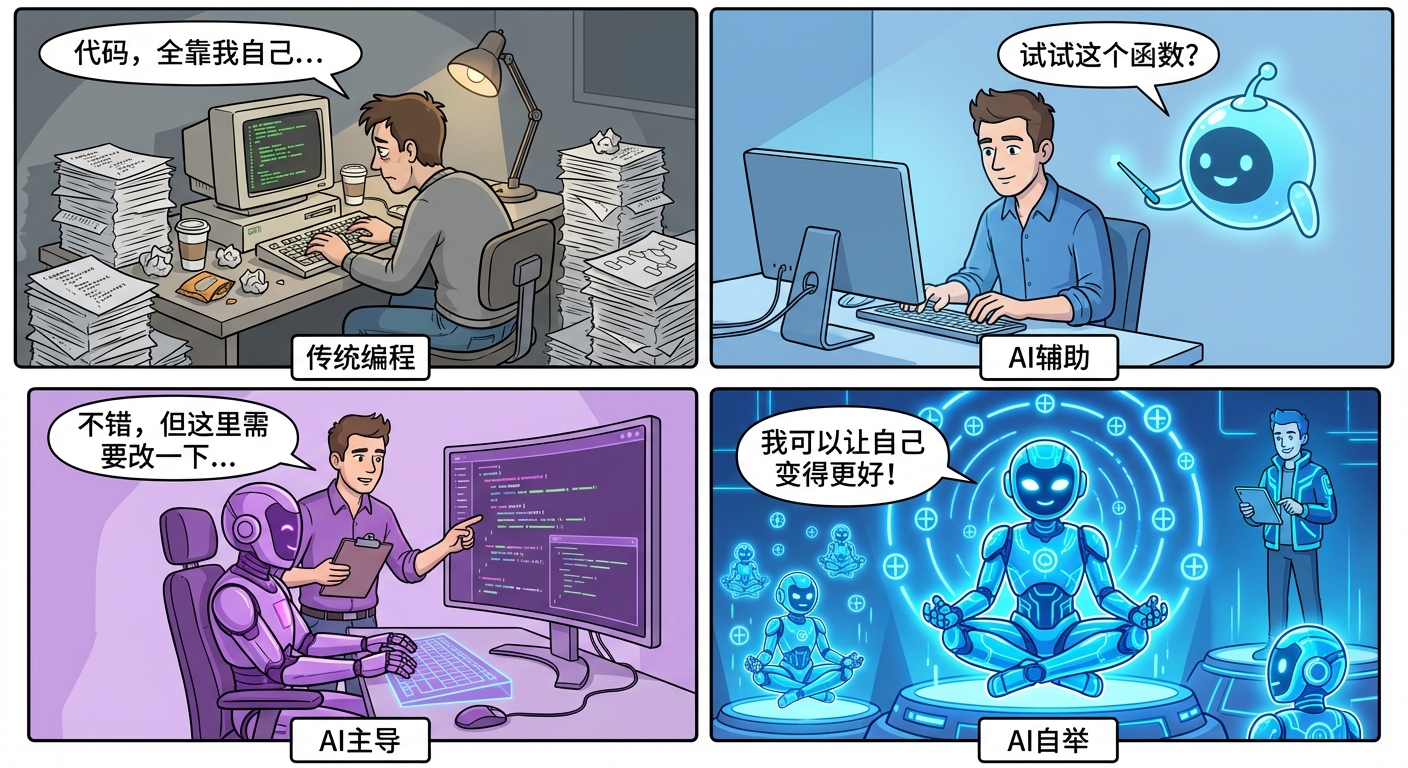
The obvious questions follow. Can AI-written code be trusted? The answer depends less on whether an AI wrote it than on test coverage and review processes. Claude Code’s ability to generate tests is an advantage, but final responsibility still belongs to human engineers. Can bootstrapping lead to loss of control? Bootstrapping is not the same as autonomous decision-making. Humans still set goals, boundaries, and values. AI writing AI code is closer to advanced automation than to independent consciousness. And if AI can bootstrap, what remains for human engineers? Creativity in defining problems and designing architecture; judgment in weighing trade-offs and making decisions; responsibility for how systems behave. Osmani’s framing is apt: AI moves engineers from writing code to orchestrating it.
If 90% of code can be self-written, development cycles for new features could shrink dramatically. AI may manage systems more complex than humans can comfortably hold in view. It may also explore design patterns people have not considered. But the same shift raises harder questions: where should the boundaries of bootstrapping be drawn, how can self-improvement be kept aligned with human values, and how will the core skills of engineering change?
The milestone is better understood as a starting point than a finish line. AI can write its own code. Under human guidance, it can keep improving the system it runs on. What emerges is not simply a faster coding tool but a different model of collaboration. The tool is beginning to write itself. The more interesting question is what engineers choose to build with it.