On April 19, in Beijing's Yizhuang district, a bipedal robot ran down a race course while its engineers followed behind on electric scooters. At some point, it simply outran them.
That is the reality of 2026.
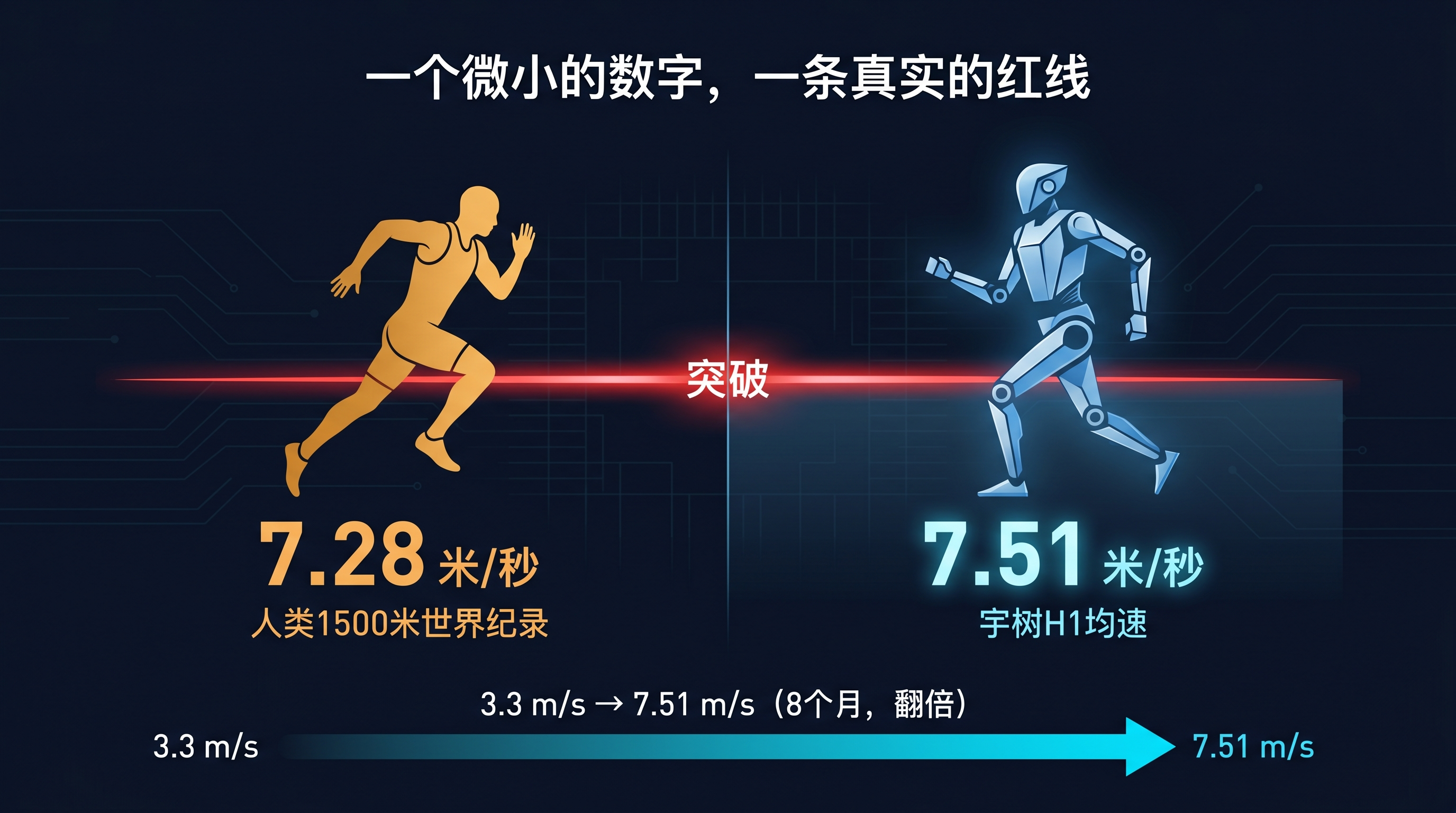
7.51 vs. 7.28: A Small Number, A Real Threshold
The human 1500-meter world record belongs to Jakob Ingebrigtsen of Norway, set at the 2024 Paris Olympics: 3 minutes 26 seconds.
Convert that to speed: 7.28 meters per second.
That is the fastest average pace a human being has ever sustained over that distance — after decades of training, selection, and drug testing. Exactly one person on the planet has done it.
Today, at the 2026 Beijing Yizhuang humanoid robot half-marathon qualifier, the Unitree H1 averaged 7.51 meters per second across the full course.
The gap is 0.23 m/s. Over 1500 meters, that works out to roughly five seconds ahead.
To be clear: the robot did not run an official 1500-meter race and break a record. The format is different — this was a half-marathon where humans and machines shared the same course. But the number still says something: on the dimension of raw speed, a robot has crossed the human limit.
Last August, the same Unitree H1 averaged 3.3 m/s at the World Humanoid Robot Games.
Eight months later: 7.51.
More than double.
Race Day: Three Hundred Robots, One Shared Course

The Yizhuang half-marathon was an unusual event.
Twelve thousand human runners and over 300 robots shared the same road. When the starting gun fired, two-legged people and two-legged machines set off toward the same finish line.
More than a hundred robot teams entered — nearly five times last year's number. Close to forty percent of those teams ran autonomously, meaning those machines relied on their own sensors and algorithms, not remote control, to decide where to place each foot.
The Unitree H1 was one of them.
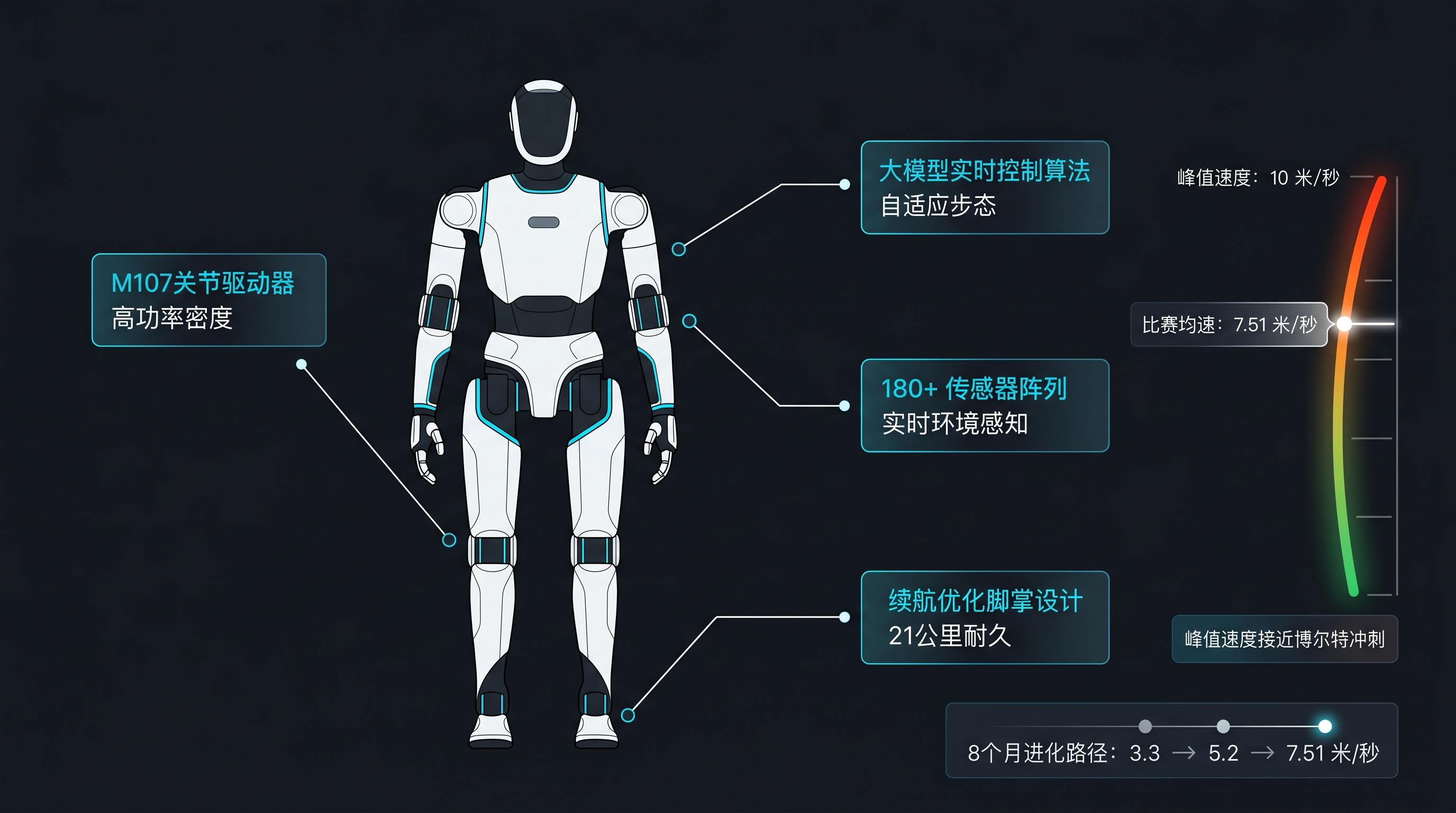
No remote. No pre-programmed route. The H1 carries more than 180 sensors that read the road surface in real time, dodge obstacles dynamically, and make every decision onboard. The only thing its engineers could do was follow on a scooter — because they couldn't keep up on foot.
This same robot won three titles at last year's World Humanoid Robot Games: the 400 meters, the 4×100-meter relay, and the 1500 meters.
This year it came to run a half-marathon. Internal test result: just over 50 minutes. Average human finishing time: about two hours.
How Unitree Got There
Behind the speed is a relentlessly compressed engineering timeline.
Joint actuation: The H1 uses the M107 joint actuator, whose power density ranks near the top among current humanoid robots. Higher power density means more torque from the same volume — the hardware foundation for running fast.
Algorithm architecture: Rather than traditional rule-based locomotion control, the H1 runs a large-model algorithm for real-time decision-making. Faced with curves, slopes, and changing ground surfaces, it adapts its gait instead of falling apart.
Speed ceiling: In an all-out sprint, the H1 peaks at 10 m/s — close to Usain Bolt's top speed over 100 meters (10.44 m/s). That is not a cruising speed, but it tells you where this machine's limits sit.
Endurance design: A half-marathon is 21 kilometers, fifty times longer than a 400-meter race. For this competition version, Unitree specifically reworked the endurance design and foot structure so the high speed could be sustained long enough to matter.
Eight months, from 3.3 to 7.51. At that rate of change, how fast will this machine run in two years?
What This Threshold Means
We usually frame AI risk in terms of "writing code faster" or "translating better." Those are information-processing tasks — invisible, intangible, hard to feel in your gut.
Speed is different. Speed is concrete. You can feel it.
The limit of human running has been part of how we understand ourselves for centuries. The Olympic 1500-meter record is a boundary that the world's best athletes have pushed outward, little by little, through decades of training and competition.
Today, a machine's average pace went past that line.
This is not an apocalyptic prediction. The Unitree H1 will not take your job, and it will not enter the Olympics (the rules don't allow it). But it tells us something: the set of things we once assumed "only humans can do" is shrinking fast.
And it is shrinking faster than expected.
In 2024, many in the industry believed robots would not surpass human athletic limits until 2030.
Today is 2026.
What Comes Next
The full marathon: With the half-marathon behind it, the next target is already 42 kilometers. The robot's endurance and stability problems get magnified tenfold over that distance — but engineering problems are, ultimately, solvable.
Factories and warehouses: High-speed mobility directly boosts efficiency in logistics and manufacturing. What a 7.51 m/s average means on a factory floor — you can do that math yourself.
Service scenarios: On the same day, at the same Yizhuang venue, Amap showed a different kind of robot: a quadruped designed to guide visually impaired people along open roads. Speed is not the only dimension. Autonomy is the real entry point.
Today we recorded a speed figure.
But what is actually worth remembering is the slope behind it. From 3.3 to 7.51 in eight months — a doubling. If that curve continues, you can work out the next few years for yourself.
There was a moment at the Yizhuang track that left many spectators frozen:
A robot ran past, stopped, and extended its hand toward a nearby human runner, as if offering a handshake.
The human hesitated for a second, did not respond, and kept running.
The robot withdrew its hand and kept running too.
No one said what it meant. But everyone who saw it paused for a beat.

Embodied Intelligence: Why This Matters More Than "AI Writing Code"
When we talk about AI, we mostly mean the "soft" kind — language models, image generation, coding assistants. That AI lives in screens, on servers, inside chat windows.
Embodied intelligence is different. It lives in the physical world.
The course the Unitree H1 ran today was real asphalt, with wind, slopes, interference from other runners, and obstacles appearing at random. It perceived real physical signals, and every decision it made had to land immediately — literally. Foot on ground.
That is both the core challenge and the core value of embodied intelligence: not "thinking" inside a virtual environment, but "doing" inside the real one.
When a robot can run an open course autonomously, at a speed beyond human limits, what it proves is not just speed. It proves that the full loop of perception, decision, and execution can now operate at high speed in an unstructured real-world setting.
That capability curve is the thing worth watching today.
From the transport robots moving goods in warehouses, to the racing robots on the track, to the navigation robots guiding blind pedestrians on city streets — embodied intelligence is moving from "the lab can do it" to "the real world can use it." That crossing matters more to daily life than any doubling of a language model's parameter count.
And the crossing is happening sooner than almost anyone predicted.