A friend who also writes a blog once asked me a practical question: if someone sets a self-proving trap around you, how do you get out? The more shameless answer—the one I used in The Mediocrity of Originality—is to set a trap of your own. Ask them: Why are you so certain you are the original? How do you prove you are not simply deceiving yourself into believing you are the original? Predict that they may switch tracks by using volume and a victim identity. And remember that the copier also becomes part of your artistic work.
Those four self-proving traps are identity destruction, logic destruction, path destruction, and forced identity binding. They are the kind of sophistry Luo Yonghao is known for, except he adds one more move: interrupt to force a change of track, so the other person is pulled out of their original logical frame and then ground down inside his. Call it the Möbius-strip world.
Before going further, I need to clarify the facts. According to the other person’s explanation, the comment left on my blog was not from him. Someone impersonated him to provoke. That comment was how I discovered that my blog theme had been borrowed without attribution. I do not mind borrowing. What escalated the matter was that the person switched tracks several times to push responsibility back onto me. Below are excerpts from our actual discussion; to avoid taking things out of context, I will publish the full exchange on the Mobius Telegram channel.
He argued that I had a moral flaw: my site had already posted a notice about impersonation, and I chose to ignore that premise and write directly. He said I had failed in moderation: my blog has no effective identity verification, anyone can comment, and treating a comment as him lacks basic logic. He also suggested I might be the aggressor: on the same basis, he could reverse it and say that the comment under his name might have been posted by me on my own blog.
So I artificially escalated the matter. I said we only needed to discuss one practical question: did the other blog borrow Mobius’s blog theme?
The response was: My writing themes and expressive path come from my long-standing writing trajectory and the issues I have long followed. They are not based on your personal blog, nor are they directed at you. It seems this was the part he felt most exposed about. Then he continued by swapping concepts and switching tracks.
Since both sides claim to be the original, proving originality requires comparing the logical relationship between the two sides on the same questions.
First, when did each blog switch to this theme? If I changed after the other person, I lose the original identity. Second, where did the original file for the same background texture used by both blogs come from? There is only one original source for that texture. If our original sources are the same, I also lose the original identity.
Now, the methodology for breaking a self-proving trap. The biggest danger is adding new traps—letting the other side set up more circular proofs. So step one: always determine what is being discussed and avoid being switched onto another track. In this case, I locked the question to: who is the original?
Step two: make a logical inference. The burden of proof lies with the one who makes the claim. If someone wants to prove originality, the timeline is the intuitive key: who published the relevant content first? When he suggested I might have left a fake comment on my own blog to frame him, I asked him for evidence. He refused to face the question directly.
But step two can have holes, such as the authenticity of evidence. That is why evidence needs the internal logic of an evidence chain and public data that cannot easily be altered—data with clear timestamps. Think of a newspaper: if it has not been bulk-recycled, its timestamp is the date printed on it. This is why a lost official seal must be reported in a newspaper; after that clear timestamp, any contract signed with the lost seal is considered invalid. What is the timestamp of a webpage? A webpage snapshot. It can serve as supporting material in an evidence chain—not as the key material.
Step three: form an evidence chain. The core of an evidence chain is inferring facts, so the other side must be allowed to provide corresponding supplementary information to complete the factual inference. Unfortunately, he refused.
First question: when did each blog switch to this theme? If I changed after the other person, I lose the original identity. So we need to prove who used the theme earlier.
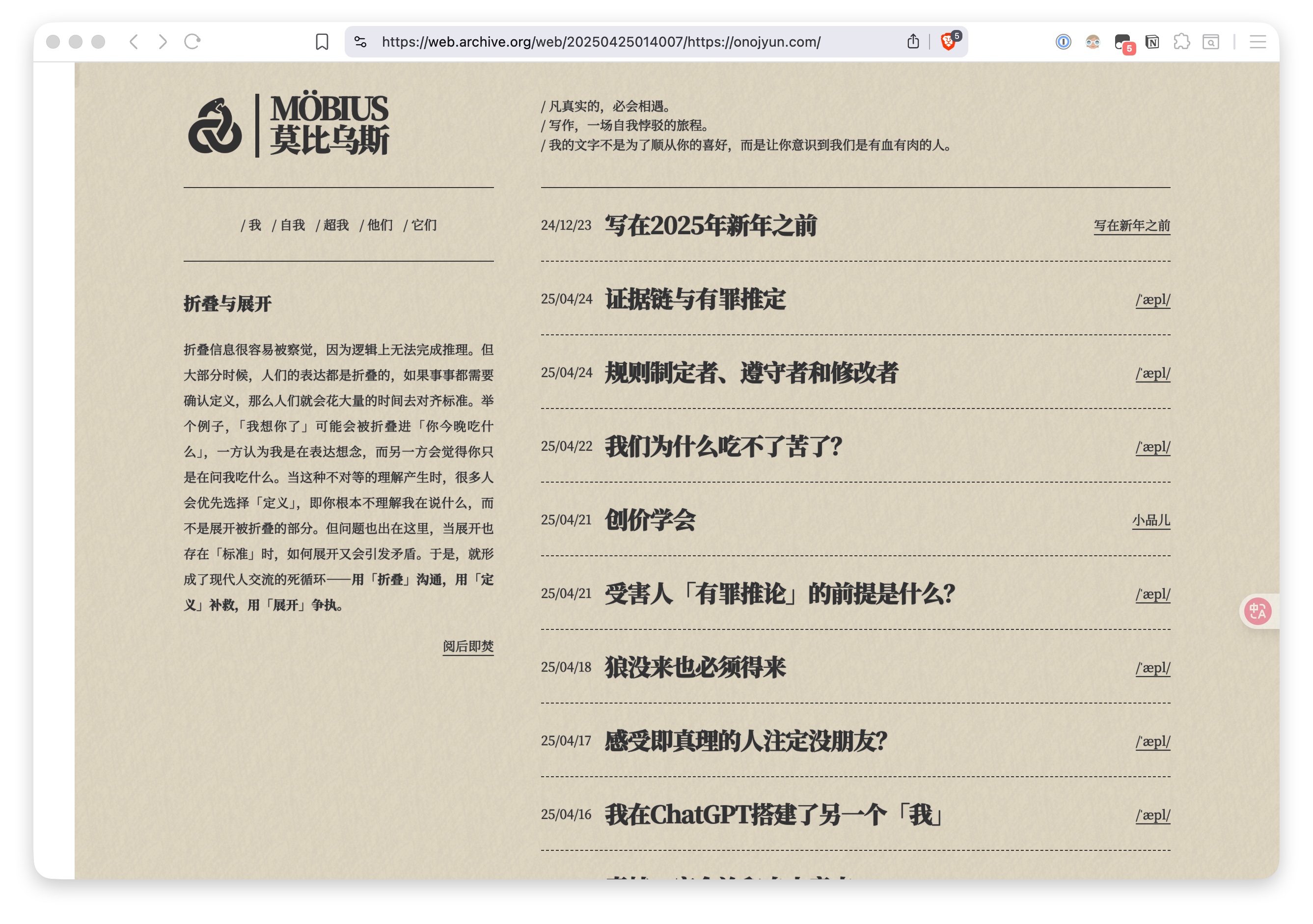
Source: https://web.archive.org/web/20250425014007/https://onojyun.com/ — snapshot time: April 25, 2025, 10:40:07.
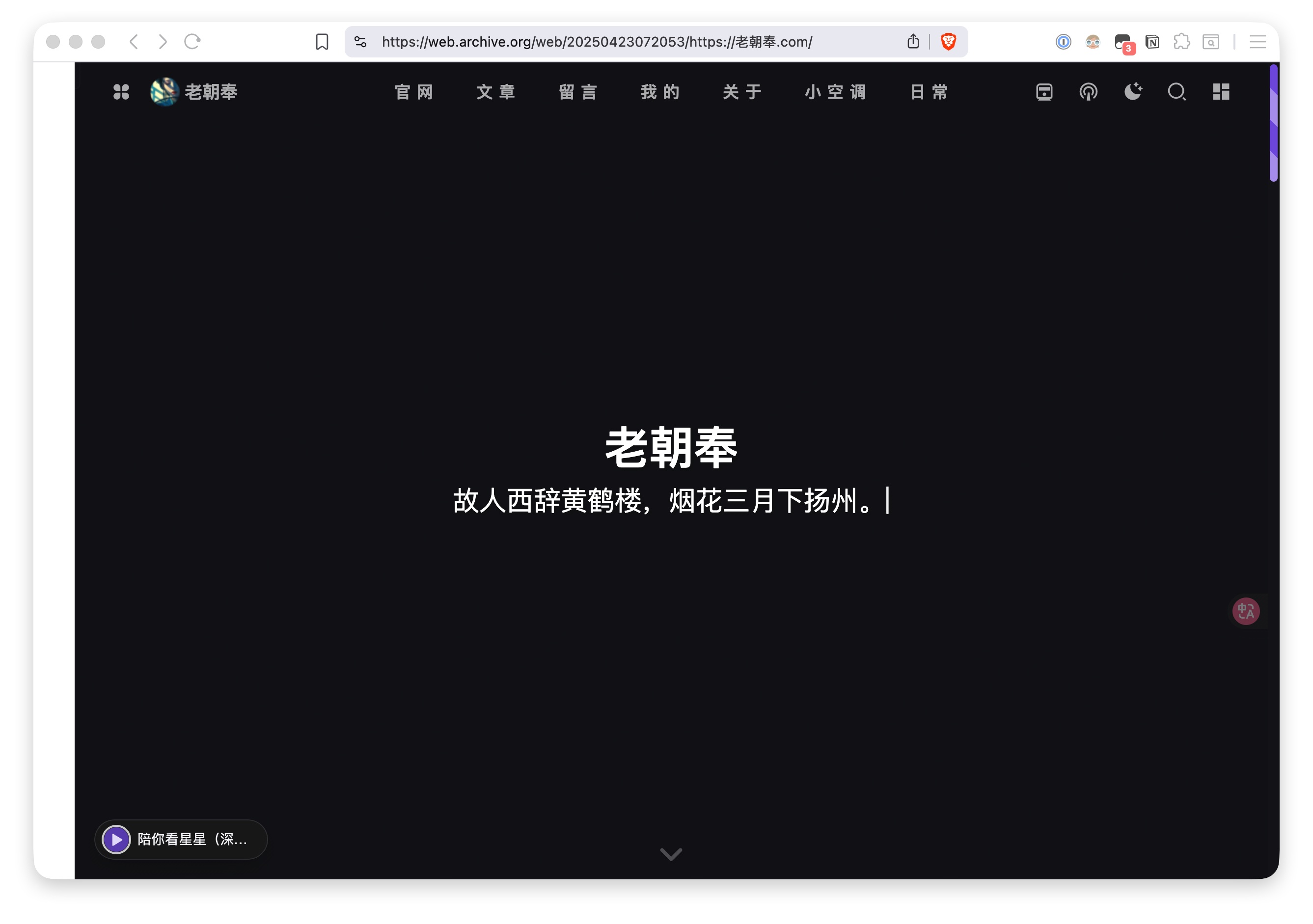
Source: https://web.archive.org/web/20250423072053/https://老朝奉.com/ — snapshot time: April 23, 2025, 07:20:53.
In terms of timeline logic, Mobius argued that his blog design came before the other person’s. The other person’s account of when the theme was modified did not mention any borrowing; subjectively, that leaves either ignorance or deliberate concealment.
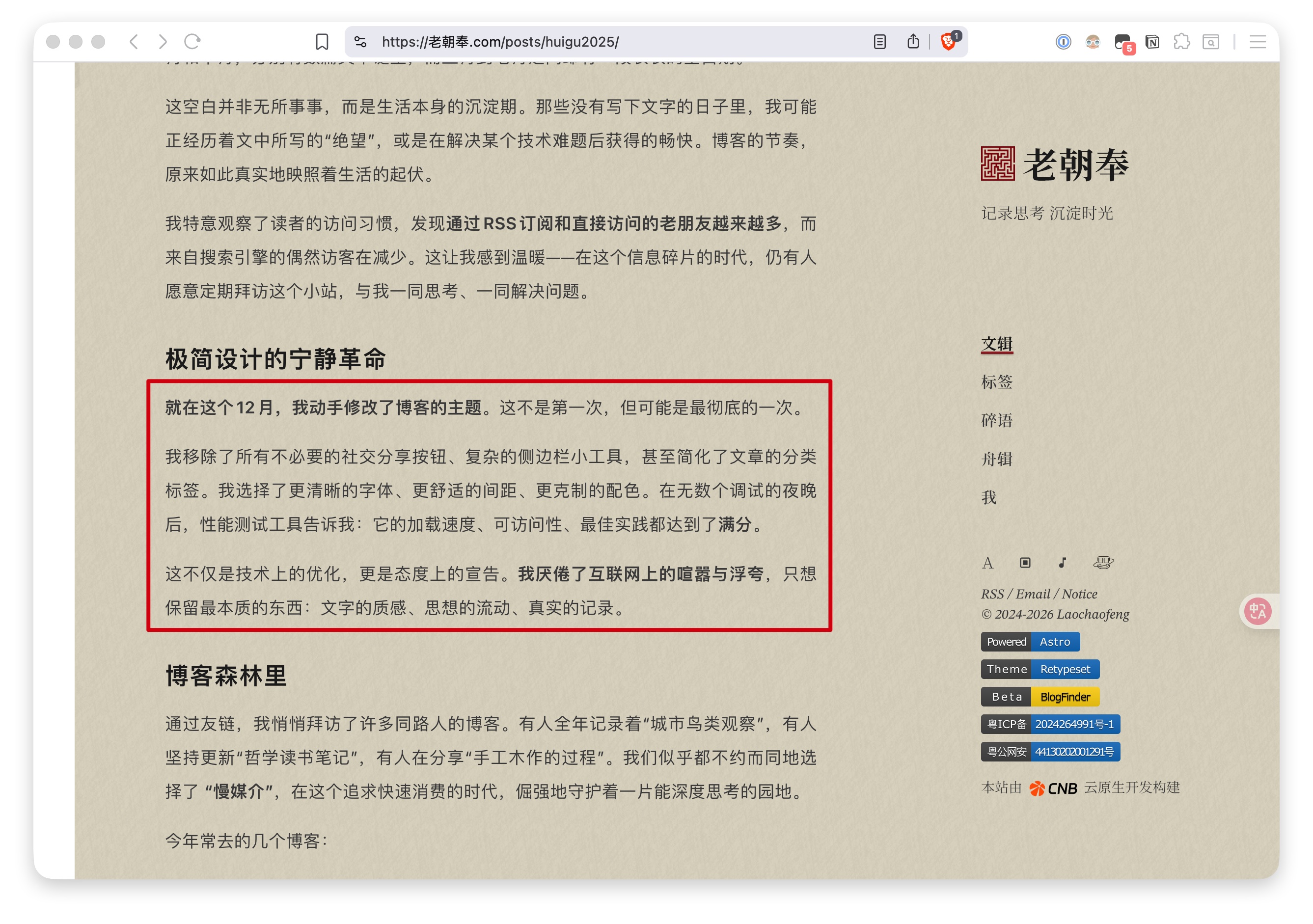
Source: https://xn--otsr53afot.com/posts/huigu2025/ — the screenshot suggests the blog theme was modified around December 2025.
So the evidence chain at this point was: Mobius used the blog theme earlier, and the other side had a subjective possibility of avoidance or concealment. But that evidence cannot stand alone. It needs another key piece: where did the original file for the same background texture used by both blogs come from? I know the only source of that texture. Providing this evidence requires both sides to act together. The other side explicitly refused and kept switching tracks: If you have evidence that I obtained content from your texture or theme, show verifiable data; otherwise the discussion has no practical meaning. The funny thing is that I never said he got the texture from me. He rushed to explain, because I also obtained the original texture file from a single source.
There is an old, rather boring way of testing a thief. A wooden basin is placed upside down over a chicken in a room. The suspects enter one by one and lift the basin to touch the chicken. If the chicken crows, that person is accused. But after all the suspects have entered, the chicken does not crow. Then the examiner checks everyone’s fingers. The basin was coated with tung oil. The real thief, afraid that the chicken would accuse him, did not touch the basin, so his hands have no tung oil.
It is boring because it is not the key to conviction. Yet it cleverly exploits human weakness, allowing logical suspicion to be raised or screened out. So when I insisted on the original source of the texture, I was essentially coating the bucket with tung oil.
Second question: where did the original file for the same background texture used by both blogs come from? There is only one original source for that texture. If our original sources are the same, I also lose the original identity. For fairness, I did not immediately reveal that single source. But if the other side keeps refusing to provide it—or keeps switching tracks and insisting that I should provide the source—then whether he touched the bucket is clear enough. This is not about conviction. It is about logical confusion and self-moral judgment.
That is step four: reverse-set the self-proving trap—joint burden of proof and comparison of evidence. The trap is not to make the other person unable to prove himself. It is to unify the path of proof, so that someone who dares not prove himself will inevitably run away.
So the methodology for breaking a self-proving trap comes down to this: always know what is being discussed and avoid being switched onto another track; make a logical inference; form an evidence chain; reverse-set the self-proving trap so that both sides prove themselves on a fair track instead of forcing only the other side to self-prove.
A special note: when I commented on the other person’s blog, I used a dedicated email address. If any creator receives inappropriate comments under my name, please contact me. I will provide the email for comparison to determine whether the comment was really from me.
I am a person who takes things seriously. I am not trying to hound someone after winning an argument. I respect logic and facts. They are tools for observing the world, not weapons for defeating others. But when you talk about logic and facts, feelings get hurt. It can even seem condescending. And it can easily slide into the weaker side is right. For example: the other person was the victim of a prank, so Mobius should not blame a victim; Mobius is relentless, so the other person has now become the victim; Mobius has made attention-grabbing arguments before and his intentions were bad, so Mobius must be the one at fault.
I did not expect this to be the second interesting apple in this series.
As of January 11 at 22:00, the situation was exactly as I expected: my blog suddenly filled with batch-generated spam comments.
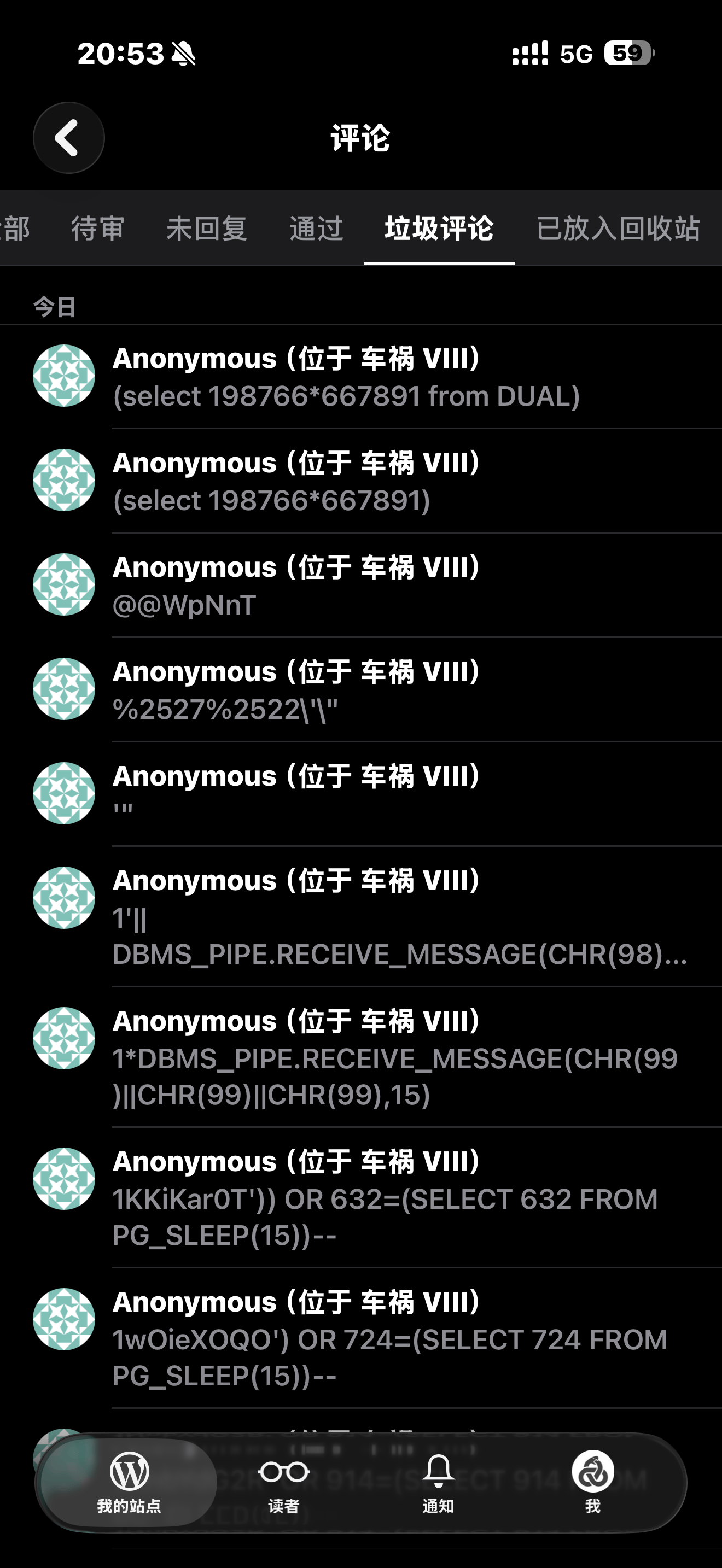
Whether this blogger, the so-called prankster, and the people using spam comments on my blog are causally connected—readers can analyze that for themselves.